Play Ideas with Trains
Trains can't go without a track. You can push a car anywhere and it goes, but a train needs the track laid first before anything starts, so the adult gets tired first. For a while I laid it all out and then called the child over, but what the child really wanted was to build it themselves.
This page was translated by Yeparksam, a preschool teacher in Korea. Some words may sound a little unusual — thank you for your understanding.
Picture books to go with this play


Printables to use
See more ›
Turning Track Pieces to Connect Them
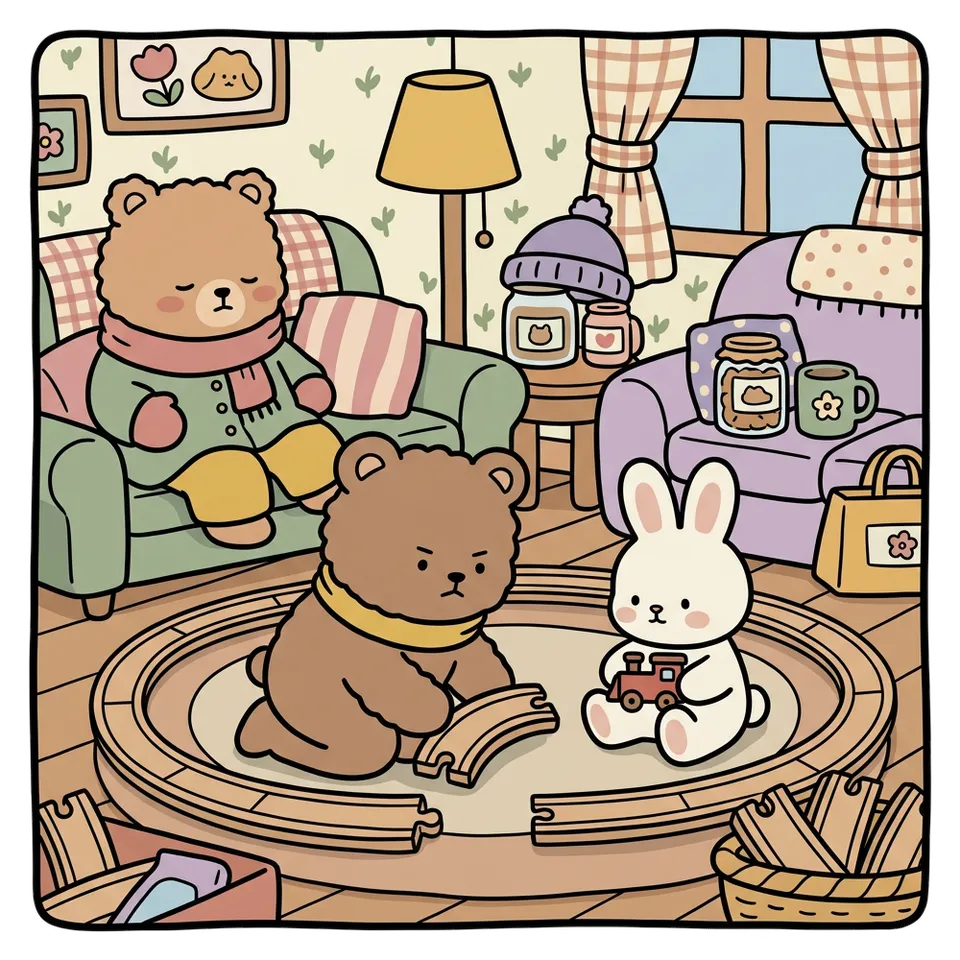
Join wooden train tracks into a path that goes all the way around. If the direction is wrong, the end will not fit.
Why it's good
When pieces won't connect, it's easy to think a part is missing and go looking for it, but often the problem is just the direction. Turning a piece around and trying it again, narrowing down the cause, is itself what makes this play good. And when the track is connected with no break, the child hardly leaves it. They don't have to pick the train up at the end and carry it back; it becomes a track that keeps going without a stop.
How to play
If it won't fit, let them turn that track piece all the way around and try it. Wooden track has a peg on one end and a groove on the other, so when peg meets peg, it won't go in however hard they press.
At first the child carried the train, which had reached the end of the track, back to the starting point and set it down again, several times. That looked frustrating to me, but when I asked once whether we should connect it, they started turning pieces and fitting them in. Once the track connected and the train had no place to stop, the child didn't get up from it. If I had connected it for them, that would have been a grown-up's track.
There was a time when a child finished laying the track and just stood looking, so I asked what needed to be there, and they said “A train needs to be there” and ran off to the basket. If they're absorbed in laying track, they forget the train itself. When there aren't enough pieces, books work too. Line them up side by side, say this is a track too, and they just use it. When I suggested building a tunnel, a child stacked books upright in a square, saying “Like this, it works,” and when done said “I'm going through,” and went through before the train did.
Until I learned this, I cleared the track away every evening. Then I left it for a day or two, and the child went straight to it first thing in the morning.
Good to know
- A curved piece bends the other way when you flip it. If it fits but the track curves in the wrong direction, flip it over and try again.
- When you run short of track, books can fill in. Lined up side by side they become track too, and stood up in a square they become a tunnel.
- You don't have to clear the track away that day. Cars are done when you put them in the bin, but a train means laying everything from scratch next time, so leave it somewhere it won't get stepped on, like under the table or in front of the sofa, and they'll keep playing for days.
What you'll need
Wooden train track (including curved pieces) · Several books
Building Separate Tracks, Then Joining
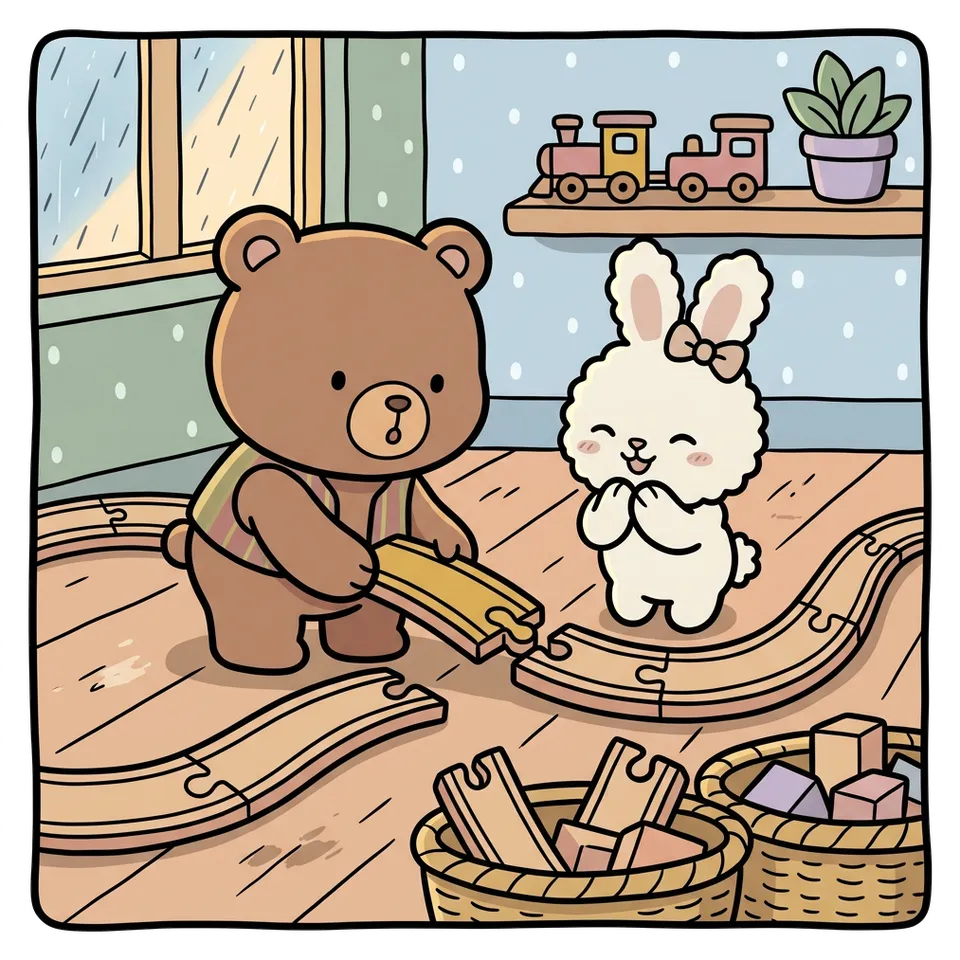
Each person builds their own track with a brother, sister, or friend who came to play, and when done, join them to each other.
Why it's good
Sometimes the child who is building and the child who wants to roll things collide. If, instead of telling them to share, you say "you build one too and we'll join them later," it becomes adding your own rather than taking someone else's. Seeing that a friend's track is short and taking out yours to attach it comes from the same place.
How to play
Once a child next to me put their own train on top of the track another child was laying. The one laying shouted “Noooo!” and the one who put it up looked about to cry. Neither meant any harm. One is building and the other wants to roll.
Instead of telling them to share, I asked whether they could make their own track and then connect them later, and the child answered right away. “First make it.. um, then merge.” Once the word "merge" comes out, it all resolves.
Then the child who had been watching came to me and said “But I'm not good at making tracks.” When I said I'd help, they started taking pieces out. In the end it was the children who filled in the gaps. One child saw that a friend's train beside them was short and said “No train,” and took one from their own basket to attach. When I asked if they were attaching it because the friend had few, they said “Yeah~ now there's lots.”
After they connected everything, the children clapped. One carried their track over and said “Let's merge with me and play,” and when the other said “Okay,” they clapped their hands. The train hadn't gone around even once.
Good to know
- If there's only one child, the adult can build their own track. Put down about three pieces and wait, and the child will come to join first.
What you'll need
Wooden train track (enough to split into one track per child)
Making One Car Each and Linking Them
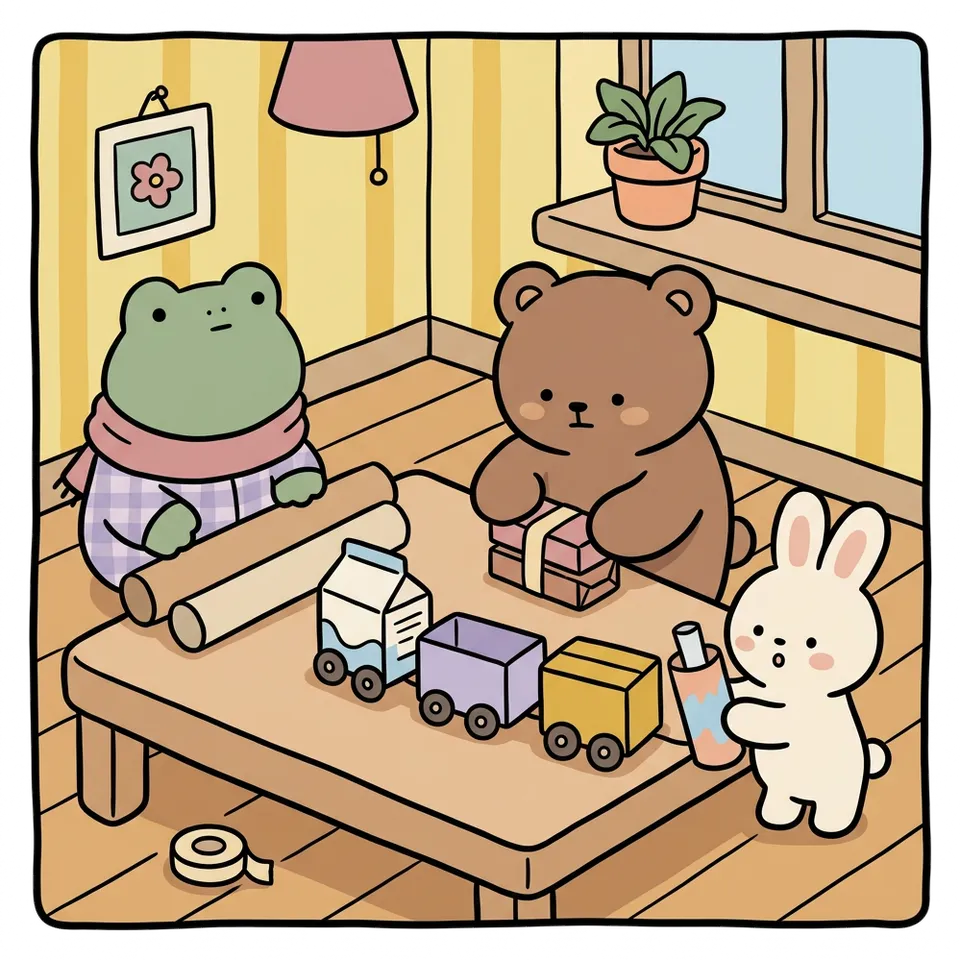
Make one train car each out of a toilet paper tube or a milk carton with a brother, sister, or friend who came to play, and connect the finished cars to each other.
Why it's good
When each makes a car, they also decide the order together. When a problem comes up, like the car falling over while they build, they think about why and how to stop it, and say it out loud. For things whose names they don't know, they call them by what the thing does.
How to play
Don't have one person make everything; give each child one car. One toilet paper tube or milk carton is one car. When they're done, they hold them up to each other without anyone telling them to. “Let's join my train and your train,” they say. They decide the order too. “This is the front so it's the engine,” and that becomes the very front.
Cars made from thin boxes keep falling over. A child watching that said “Put two boxes together, can't we?” When I gave them more boxes, they brought Scotch tape and stuck them, but when they lifted it, it fell apart again. Then they came to me and said “That tape that's sticky on both sides, you know~” It's double-sided tape, but not knowing the name, they call it by what it does. When I took it out, they tore it and stuck it on themselves.
The fall opens up one more play. While fixing it they said “Train under construction~ no trips,” and wouldn't let anyone ride until it was all fixed.
Good to know
- Milk cartons need to be washed and dried. The outside is coated so tape doesn't stick well, and if it's wet it sticks even less.
- Thin boxes stay up better stuck together in two layers. Double-sided tape sticks better than Scotch tape.
What you'll need
Toilet paper tubes · Milk cartons (washed and dried) · Boxes · Double-sided tape
Deciding Where to Go, Then Connecting
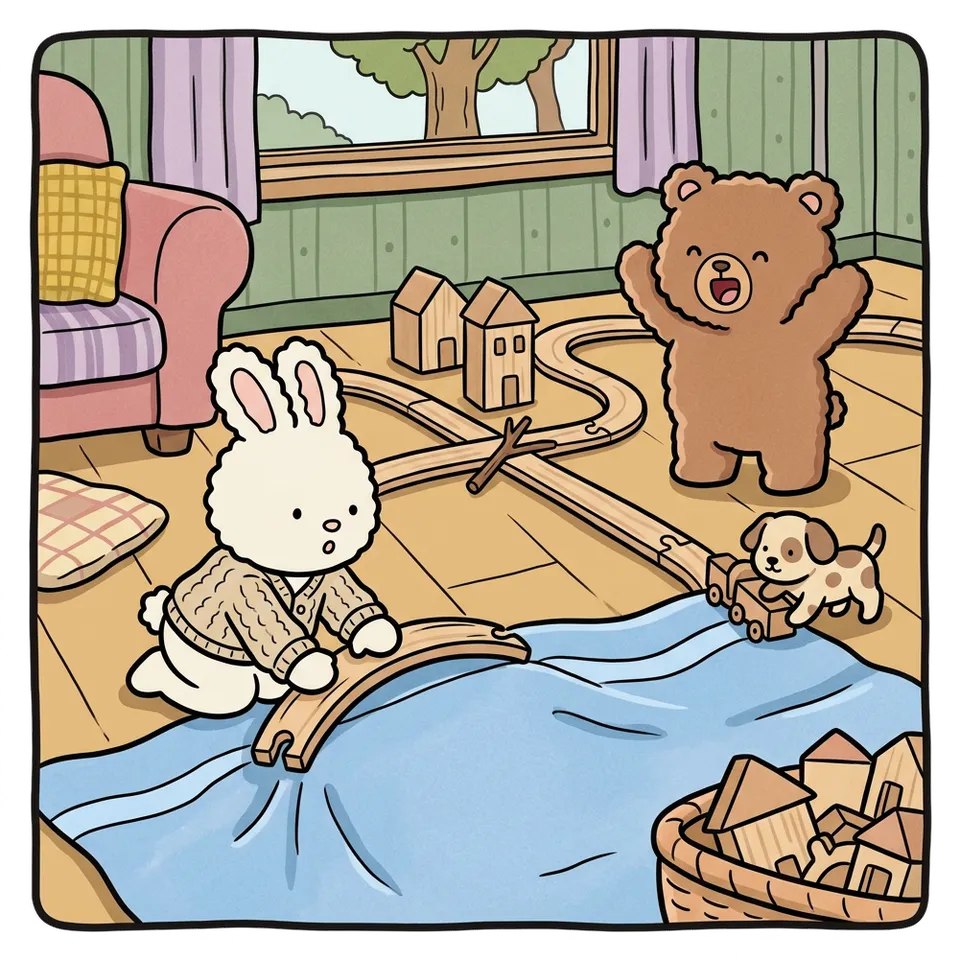
Decide the destination first, how far you will go, and keep joining track until you get there.
Why it's good
A child who found even connecting two pieces tiresome, once they decide where to go, will change direction, go off to fetch missing pieces, and stay absorbed to the end. They also decide for themselves what's beside the track and build their own world. They even remember train names by where they rode them.
How to play
If you just say connect it, they get bored quickly, but it changes when you decide first where it's going. One day a child said they'd go to the sea. “The beach is far so I have to make the track longer,” and “I have to connect here to go all the way,” they said, trying other directions and going to fetch missing pieces. This was the same child who a moment earlier found even two pieces tiresome.
Make the destination real in the room. If you spread a blue cloth or towel, that's the sea. I just laid it down and said nothing, and when the track reached onto that cloth, the child shouted. “The train went into the sea!”, “It's an undersea train!” and then “It can go underwater too!” and from there an underwater story began.
The child also decides what's beside the track. When I asked whether they weren't going home, they dug through the bin and stood up building blocks one by one. Then they placed a block printed with the word "Bank" and said “This is the hospital.” Reading the word to them doesn't help. To the child, that is the hospital.
Sometimes they put a crossing on the track. They laid one stick across and called it the gate, and when the train came, said “You have to pay money to open the gate.” It was mixed up with a tollgate, but nobody argued.
Once where to go is set, what train to go on follows. Some children name them: “This is a KTX, it's super fast. There's also an ITX but it's slower than KTX.” I still mix those two up, but the child remembers them by where they rode them. “This is the train you take to the countryside,” like that.
Good to know
- The child places the last piece. The moment the track reaches the destination is when they laugh the most, and right before it does, the adult's hand always goes out first. Holding back is the adult's job.
- You don't need to correct it if the child gets something wrong. In the child's world it's right, and it doesn't get in the way of playing.
What you'll need
Wooden train track · A blue cloth or towel · Building blocks · A stick (for the gate)
Making a Track Going Down
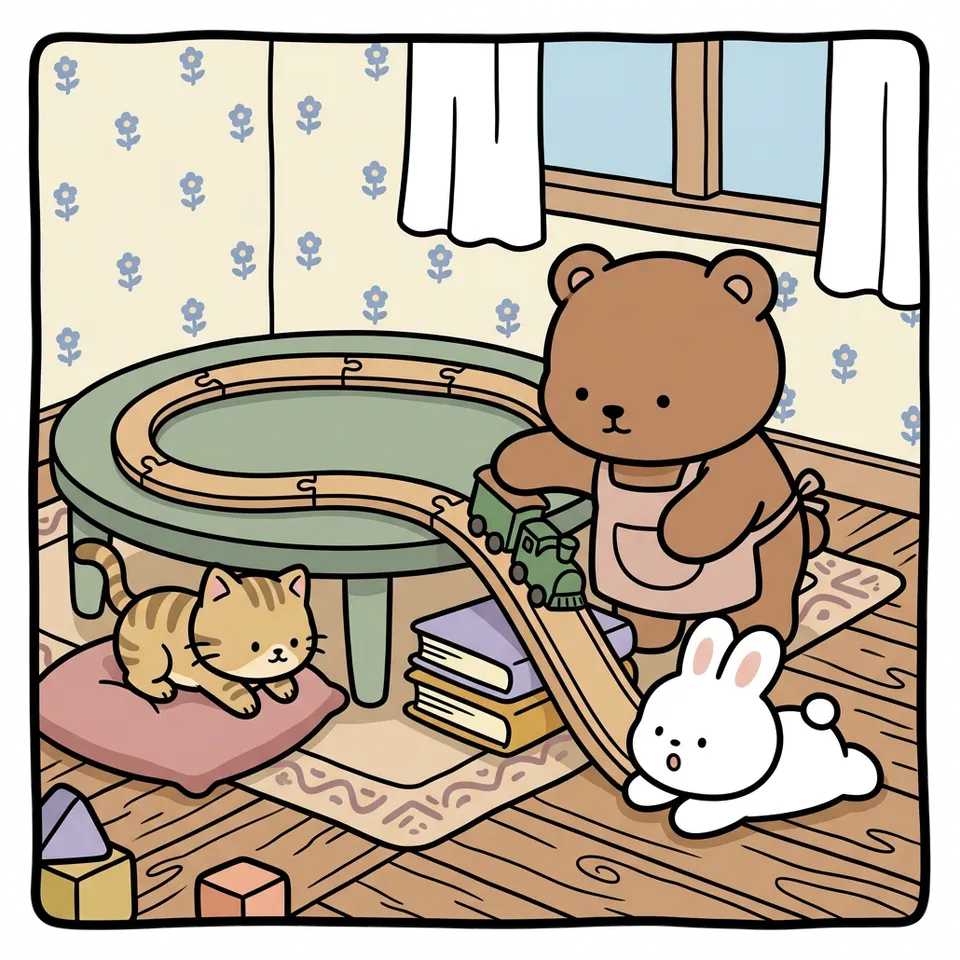
Lay the track up high like on a dining table and build a path for the train to go down.
Why it's good
Children learn with their body that a track to cross and a track to go down are different, only after lowering one end and laying it at a slant.
How to play
If you lay the track on a table instead of the floor, the train that only went around up there goes to the table's edge and stops. From then on the child looks down. Pointing under the table they said “How does it go down?”
The first thing the child does is build a bridge. They lay a block across, and when that doesn't work, they bring a book and lay it across. But the train doesn't go down on that. A piece laid across is flat, so it's a track for crossing, not for going down. After trying for a long time, they looked at me holding the train.
When I lay one end of the track lower so it slants, that's when it works. You can unfold a thin box and rest it on the table's edge, or with wooden rails you can put one or two books under the track and tilt the whole thing.
Good to know
- Going down once isn't the end of it. “Train going down~” they say, then pick it up by hand and carry it back up, over and over on their own. The train goes down; the child does the going up.
What you'll need
A dining table or a desk (a high spot) · Wooden train track · Blocks or books (for bridges) · A thin box
The Train Has to Tip Over Before It Slows Down
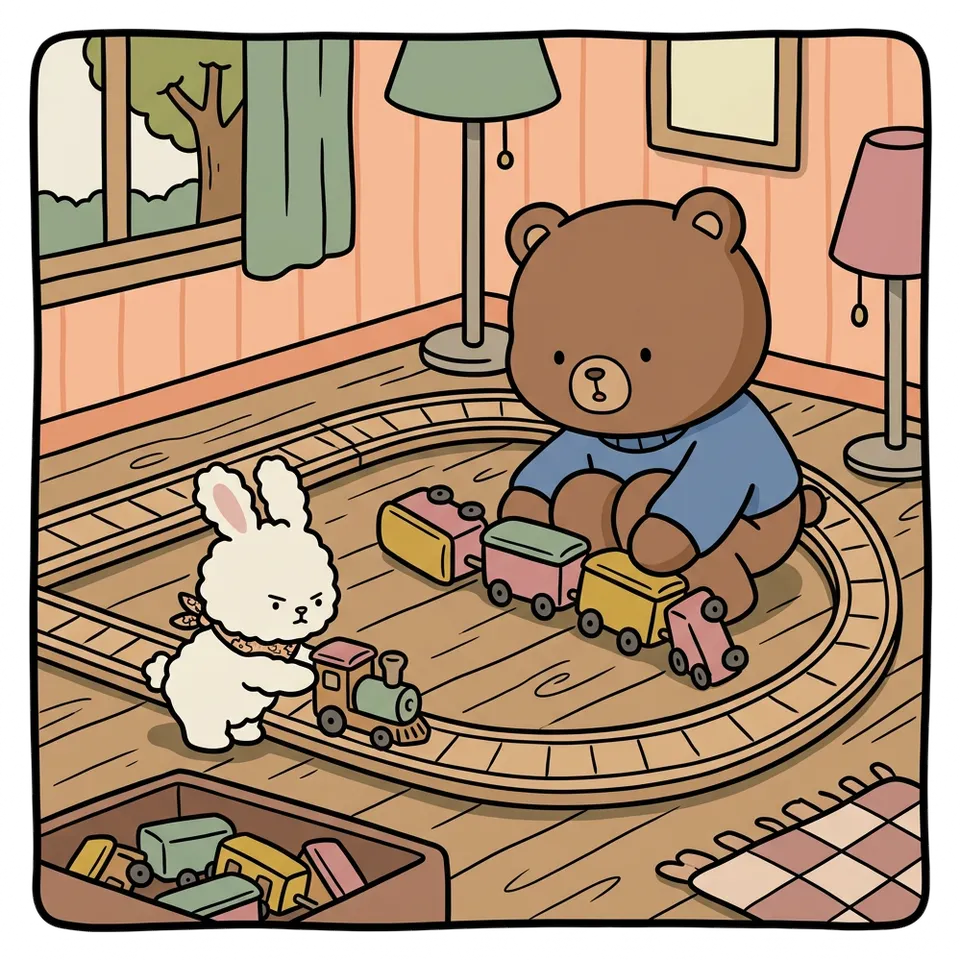
After the train tips over on a curve a few times, the child begins to slow down how fast they push on their own.
Why it's good
Telling a child to go slowly doesn't slow their hand, but after the train tips over a few times, it slows by itself. The body knows before words where to slow down.
How to play
If you say go slowly, they won't slow down. On straight parts they can push as hard as they like, but on curves the train tips over. At first I explained that it was because they were going fast, but I never saw a child slow down because of that talk.
After about three tumbles, the hand slows on its own. The first two times they stood the fallen train back up and pushed fast again, but from the third time on, their hand slowed by itself in front of the curve. Then once past it, it sped up again.
When one child starts pushing, a sibling or friend watching gets up too. They go get their own train, put them on the track one by one, and push along. Then the back train bumps into the one in front. When it bumps, the child in front doesn't like it. “Stop it,” “This is mine,” they say. Then the child pushing from behind pulls their train off and leaves a gap. The hand that slowed on curves after tipping over now slows on the straight track too.
Good to know
- Link several cars into the train. A one-car train just passes through curves and never tips. You need three or four linked for the back cars to get pushed over on a curve.
What you'll need
Wooden train track (including curved pieces) · Several trains
Putting a Doll Bigger Than the Car on the Train
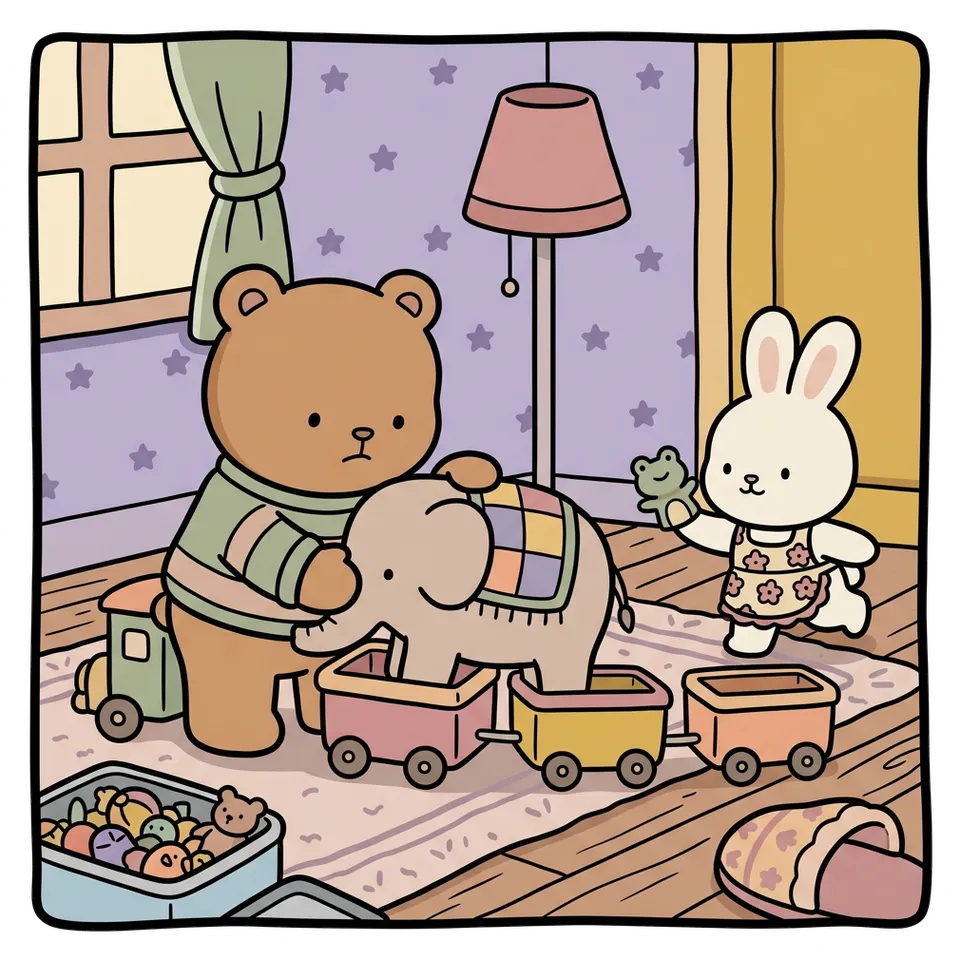
When a doll within reach is too big for a train car, find one small enough to fit and put it on the train.
Why it's good
The heart of this play is the child finding, on their own, something small enough to fit. Each time a car is added, they go off looking for something to put in it, and it even goes as far as naming each car.
How to play
The doll in hand is usually bigger than the car and won't fit. But the play starts right there, from not fitting. Adults try to find a bigger train, but the child wanted that train. If you bring something else, they won't take it.
You only need to say let's look for something that fits. When the doll wouldn't fit and the child froze, I just said there must be something smaller somewhere, and after looking around the room, they came back with a small animal finger puppet. They put it on and kept wandering around the room.
If you link one more car, they go looking for something else to put on. They don't link because they like it getting longer; they link because there are more places to put things. One child lined up blocks, then seated dinosaurs one by one, dividing up the seats. “This is the dinosaur seat,” “This is the baby dinosaur car,” they said. When milk cartons were linked, they put insect models in, saying “The stag beetle goes here!” Whenever a car appears, one creature goes in, whatever it is.
Good to know
- Keep small dolls that fit in the car together in one bin. Searching time gets shorter.
- But at this age you have to stay beside them. What fits in the car also fits in the mouth.
What you'll need
A train · Small animal finger puppets or insect models
One More Car If There's No Seat
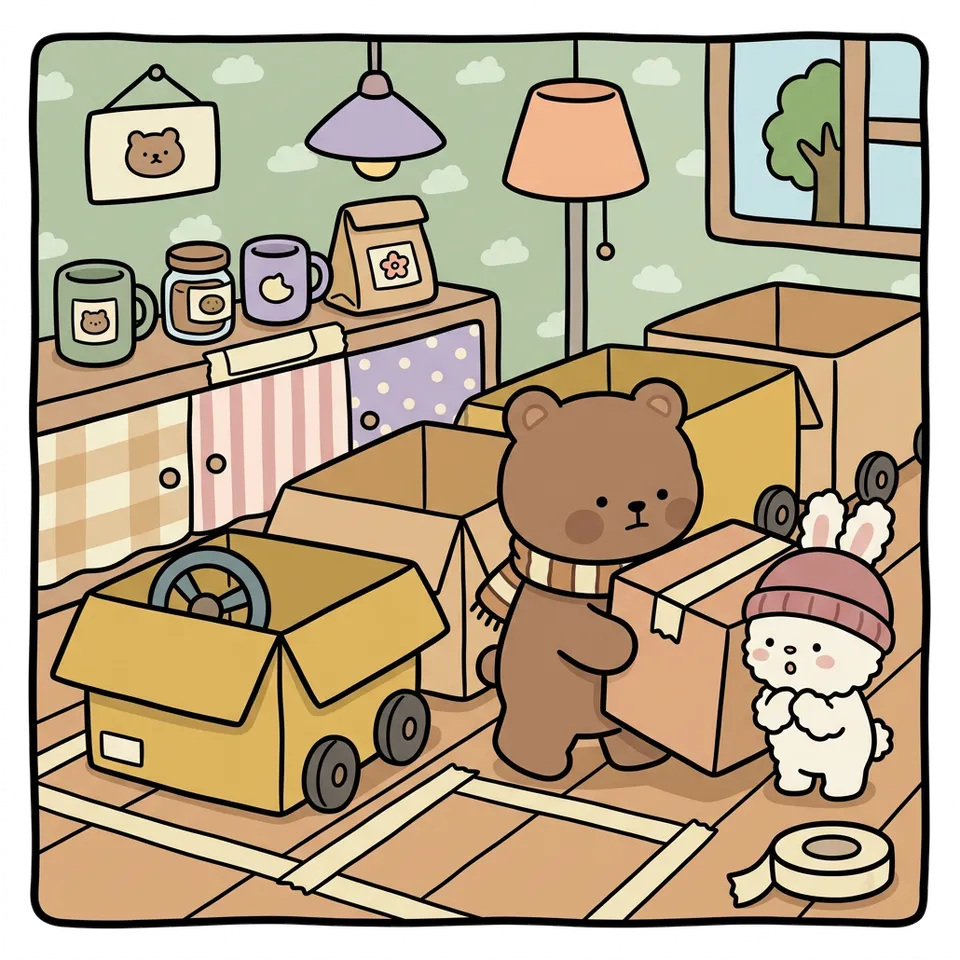
Line up big blocks or boxes side by side and sit on them, and that is a train. The child in front is the engineer.
Why it's good
The heart of this play is what children do when there isn't enough room to ride. It shows when a child who is already seated makes a seat for one who arrived late.
How to play
The child at the front is the engineer, and the others sit down behind one by one, deciding for themselves, “I'm car number 2!”, “I'm the tail car!”
When a child who came late stood there saying “There's no seat for me,” the child sitting in front said “Wait a minute!” and brought a block and attached one more car behind. With a car, if there's no seat then there's no seat, but with a train you attach one and it grows. The child knows that first.
Once they're seated, roles appear on their own. One waved a hand saying “Inspection!”, so I held out my hand to ask them to check my ticket too, and they said seriously “Stamp! You pass!” After that everyone steps up saying “I want to be a conductor too!”
With several siblings or friends on board, they squeeze together and push each other, saying “It's tight.” When one said “I wish there were chairs,” I drew squares on the floor with masking tape to divide the cars, and each went and sat in their own square and the bumping stopped.
Good to know
- What you sit on needs to be big blocks or boxes. If you line up small blocks, they collapse the moment someone sits on them.
- With several children, mark seats on the floor with masking tape. They stop pushing each other while squeezed together.
What you'll need
Big blocks or boxes · Masking tape
Walking Out Holding Shoulders
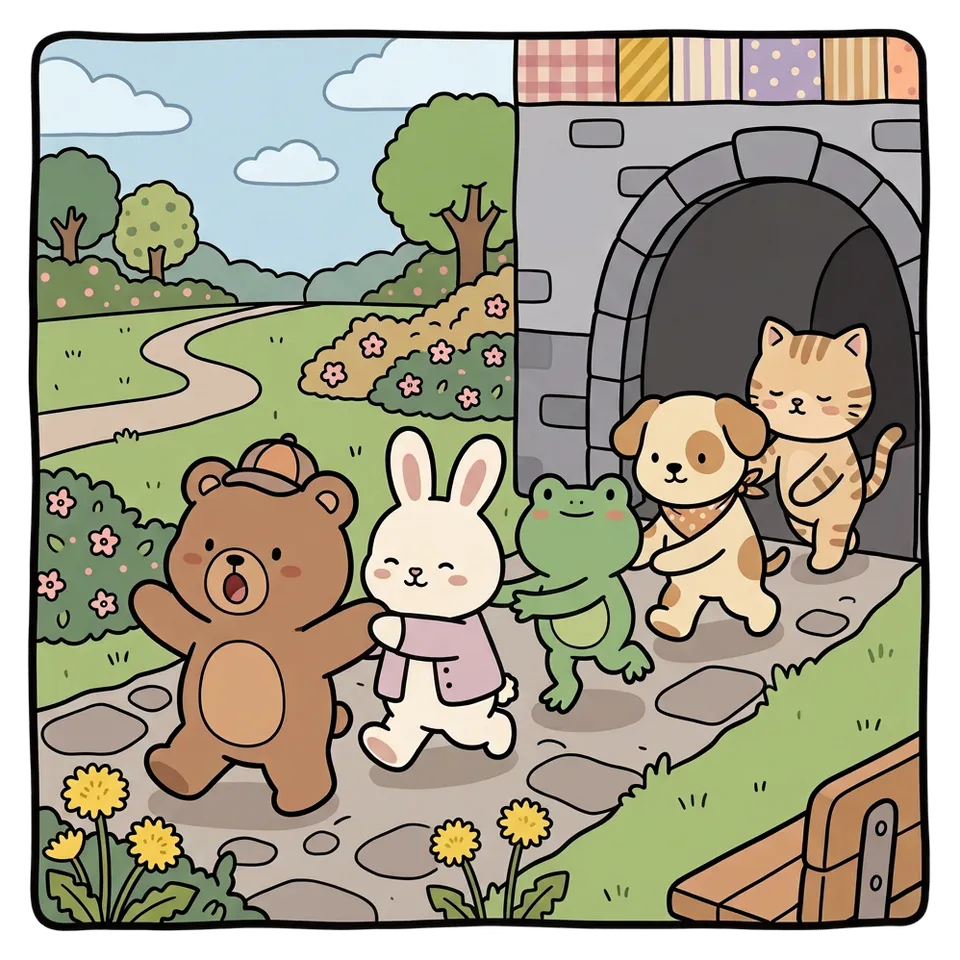
When going outside, hold the shoulder of the person in front and walk in a line to be a train.
Why it's good
A path you always walk becomes a route when you walk it holding shoulders. Even with just two, the child feels it is long. An underpass or a pedestrian tunnel becomes a tunnel, and coming out into the light after passing through the dark, the place you always pass looks brand new.
How to play
When going outside, go out as a train. You walk holding the shoulders of the person in front. When a child gripped their older sibling's shoulders and shouted “Let's go!”, the older one in front laughed, “It's long!” There are only two, and they say it's long.
It's a path they always walk, but as a train it becomes a route. One child said as they stepped out the door, “Today we're going far.” They also keep saying what they see along the way. “Going to see flowers!”, “Look, a bus!”
When you reach an underpass or pedestrian tunnel, that's the tunnel. The child stops at the entrance. “It's dark,” “So dark,” they say. Don't turn back then; try walking in slowly. Inside, voices echo. “My voice echoes,” they said, and from then on made sounds on purpose. They say “A little scary,” but as long as you hold their hand they go all the way.
The best part is the exit. Coming out into the light after the dark, everything ahead looks brand new. It's a place they pass all the time, but they say “Wow!”, “It's so wide!”, “We came on a trip.” Those words wouldn't have come if we'd just walked.
Good to know
- Stopping at the entrance doesn't mean they want to quit. If you just hold their hand, they go all the way.