Play Ideas with Stuffed Animals
Unlike other toys, stuffed animals never get thrown away. Even when an arm comes off and the color fades, they keep their place, though the only time they really get picked up is for sleeping with. Then comes the day a child pulls out the whole pile and lays it all out, and right there they decide which animal lives where and who is in whose family.
This page was translated by Yeparksam, a preschool teacher in Korea. Some words may sound a little unusual — thank you for your understanding.
Picture books to go with this play


Printables to use
See more ›
Building Each Animal a House
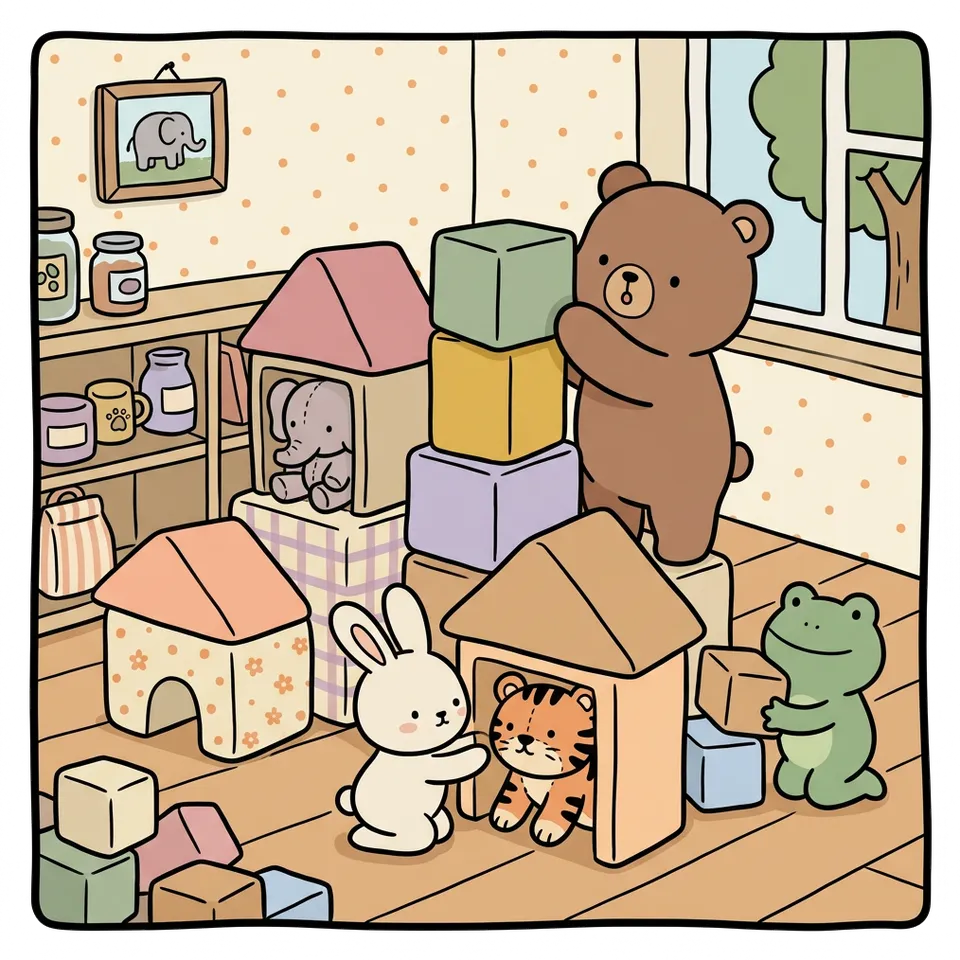
Build a separate house for each animal out of blocks.
Why it's good
The size of the house shows the animal's size and strength. Some children build up floors, saying “This is the elephant house, second floor, third floor...”, while others build big houses for strong animals and even give the reason, “Tiger is strong so the house is big.”
How to play
Once you put one animal into a block house, from then on the child builds all the other houses alone. They put the animals inside one by one, deciding places, “This is the lion house.” Collapsing is half of this play. The higher they build, the more easily it falls, and only I am sorry about it. The child calmly picks the blocks back up and builds again, lower than before. When every house is built, they visit each other's houses, and if you connect the houses in a row they become a train, and if you put animals on top, a zoo.
Good to know
- Big light blocks are better than small ones. At this age fingertip strength is weak, so small blocks keep falling as they stack, and if that repeats, children get annoyed and give up.
- You need a few stuffed animals of different sizes. Only when big and small are mixed does the housing split into big and small too.
What you'll need
Big light blocks · Several stuffed animals (of different sizes)
Pretending to Be Animals
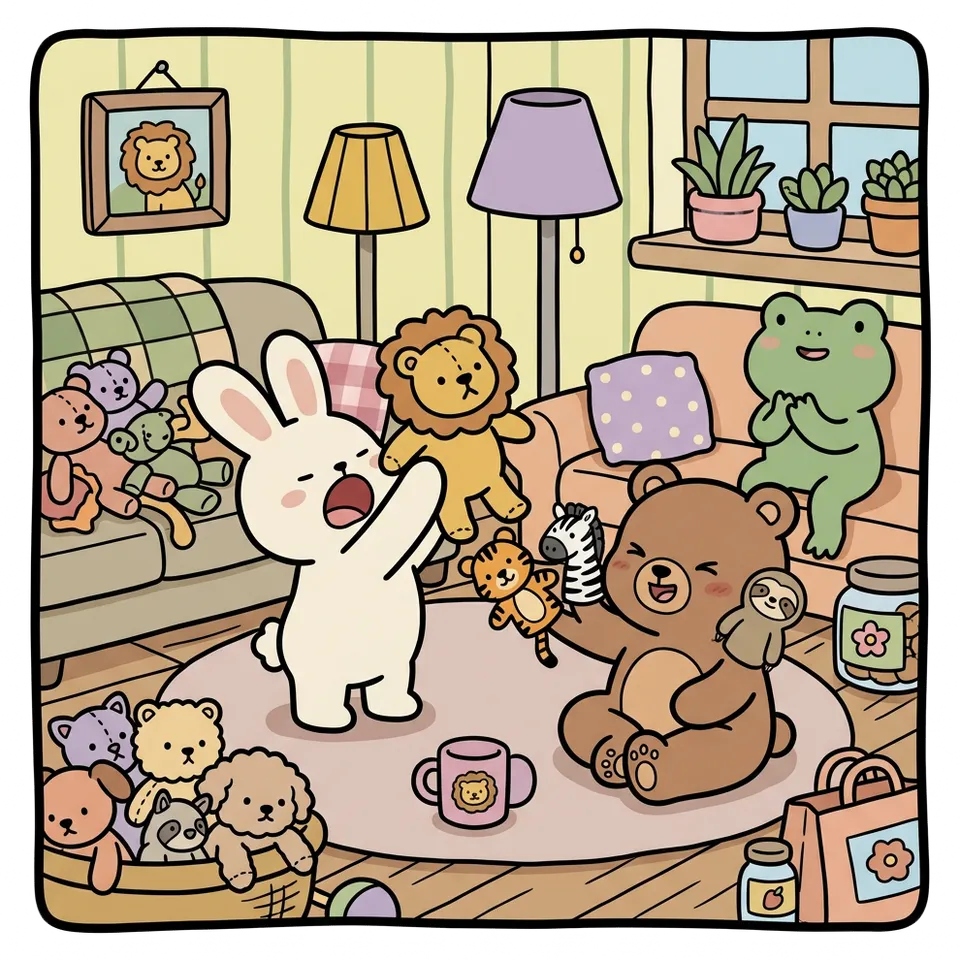
Hold a stuffed animal and become that animal, making its sounds and moving like it.
Why it's good
Children show with their bodies that they can tell animals apart by their sounds and movements. If you put a stuffed animal on each finger and ask “I'm a tiger, who are you?”, each one introduces themselves, “I'm a rabbit,” “I'm a lion.” Then they go on to what that animal likes, telling you “Rabbits like carrots,” “Lions eat meat.”
Books to read together


How to play
The moment a child holds a stuffed animal, they become that animal. Pick up a rabbit and they hop hop, pick up a cat and they cry “Meow meow.” A child holding a lion gets a louder voice first.
Ask where it lives too. If you hold up a sloth and ask “Where do you think this lives?”, they think a long while and say “It lives in a tree.” When you tell them “It lives in a forest with lots of trees,” they repeat “Yes, it lives in the forest,” and next time they say it first.
You can also give only clues and have them guess. If you say “I have stripes, I like carrots too, and I look a bit like a horse, who am I?”, animal names pour out one after another until they finally stop at zebra.
Good to know
- Children don't know every animal name and sound. If they don't know, they just make it up. It doesn't matter if they are wrong, becoming that animal is the play.
- It goes better on days after a trip to the zoo or a farm. They try to move what they saw into their bodies just as it was.
What you'll need
Several stuffed animals (many kinds)
Opening an Animal Shop
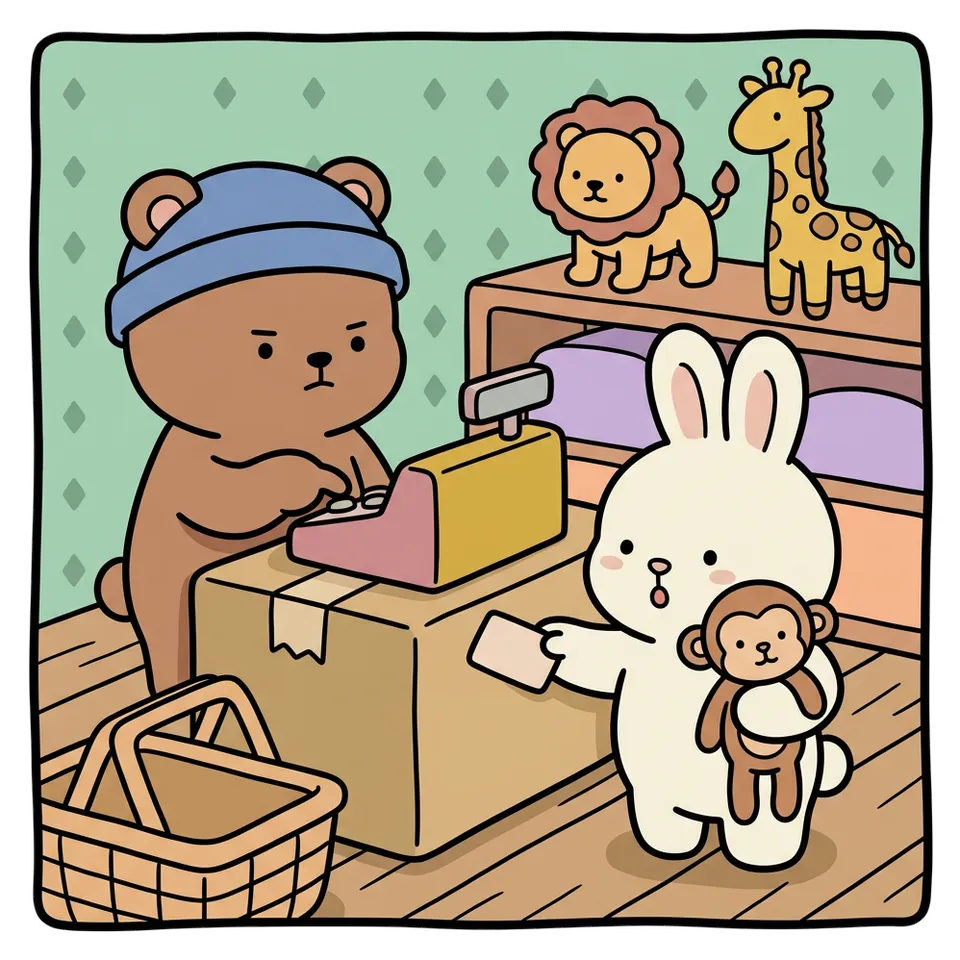
A shop role play that buys and sells stuffed animals. You take turns being the customer and the shopkeeper.
Why it's good
It is good for repeating, in their own way, shopping they actually experienced. Taking turns as customer and shopkeeper, they exchange the words for setting prices and paying on their own.
How to play
The memory of shopping the day before comes back the next day as shop play. One button for a cash register and the preparation is done. When you hand over a bear and ask “How much is this?”, they pretend to tap on the register and answer “It's 1,000 won.”
The price is up to the child. When I went in as a customer, picked up a bear and asked how much, the answer was “390,000 won,” and I was startled right then. Ask another child about the same bear and it is “8,000 won.” They repeat buying and selling, taking turns as customer and shopkeeper, “A bear, please,” “It's 1,000 won,” “Thank you,” and when they even pretend to pay by tapping a card, from then on it runs like a real shop.
They don't just leave the animals they bought. A child who walks off holding the monkey they paid for says “I'm taking the monkey with me,” and siblings or friends who came to play follow in a line, each holding the animal they bought. The shop play had turned into a walk.
Good to know
- Once about ten stuffed animals gather, that's when it becomes a shop. If you don't have a register or shopping basket, one box is enough.
- When customers crowd in, quarrels come too. The moment comes when both want the same stuffed animal, “No, it's mine,” and if you set a turn, “I'll lend it after a few times,” they go back to playing.
What you'll need
About ten stuffed animals · A register or shopping basket (or one box)
Feeding Favorite Foods
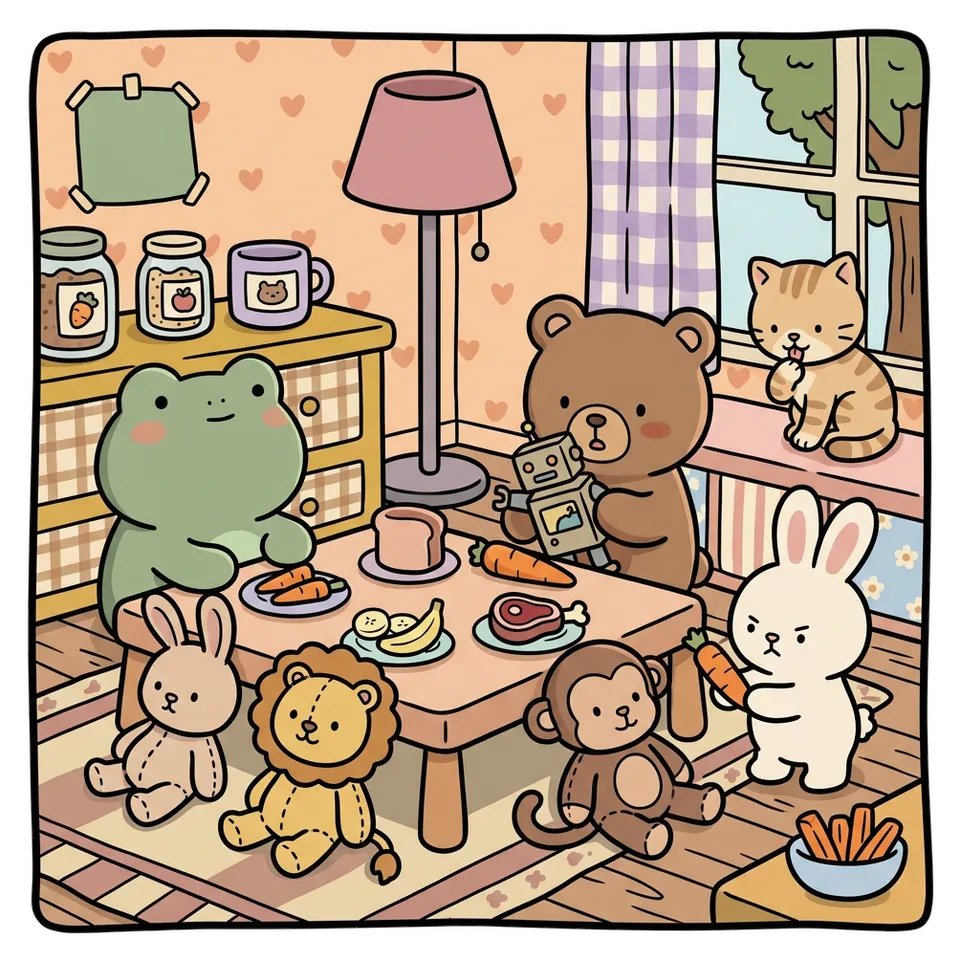
A role play of finding each animal's favorite food and feeding it.
Why it's good
Getting it wrong is where this play starts. When an animal and food are mismatched, it shows right away, and children correct each other, “Rabbits like carrots,” “Lions eat meat.”
How to play
I used to think it was fine to feed any animal anything. But the children catch that uncannily well. A child came with a robot toy and tried to feed it a carrot, saying “It's hungry,” and a child next to them cut in seriously. “Hello Carbot can't eat carrots, rabbits eat carrots~ I like rabbits!” The child with the robot agreed right away, “Right!” and brought their own rabbit to feed the carrot. Carrots for rabbits, meat for lions. The child finds the right pairs one by one.
Good to know
- Real vegetable pieces work instead of toy food. A child who had been pulling carrots once linked it on their own, “Rabbits like carrots.” Real food in front of them is actually quicker than a toy.
- The animals shouldn't be all the same kind. You need several different animals for food matching to work.
- Small toy food can go in the mouth. For children under 3, stay beside them.
What you'll need
Several stuffed animals (many kinds) · Toy food (or real vegetable or fruit pieces)
Walking on a Leash
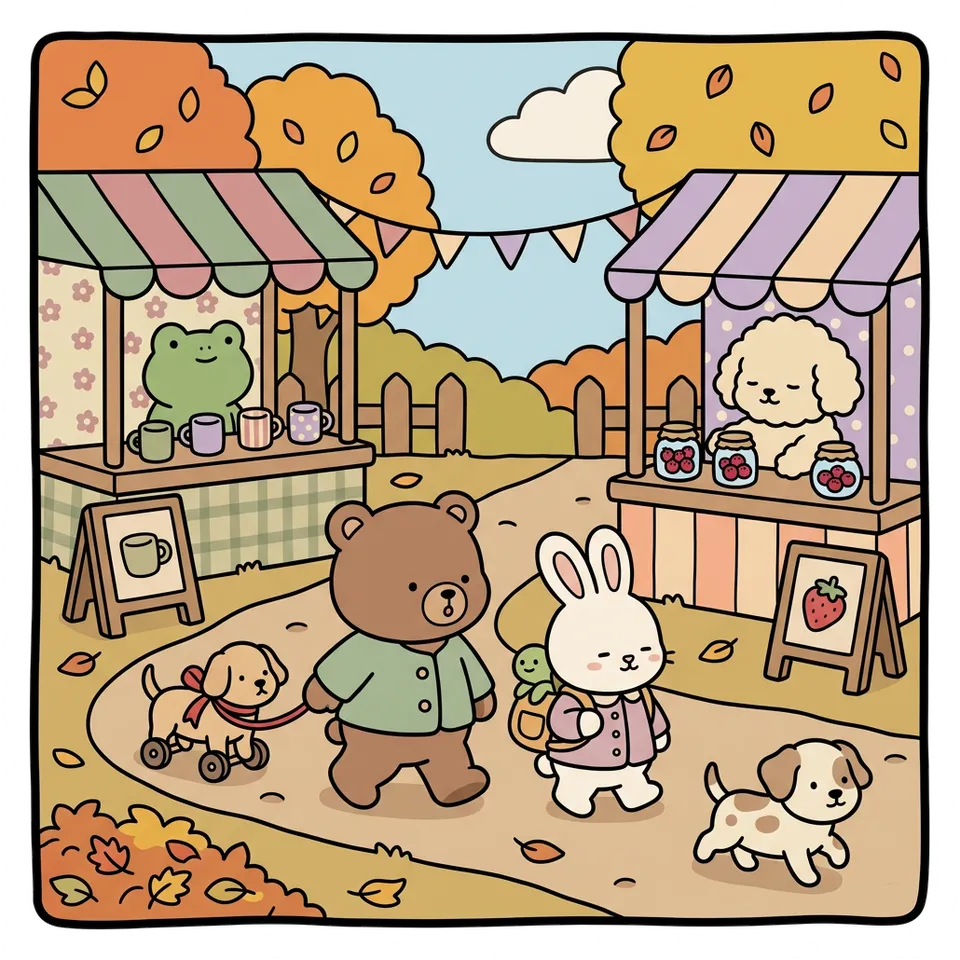
A role play of walking a doll by putting a string around its neck.
Why it's good
This is play where a child's feeling of looking after the animal shows. Looking after the rabbit because it likes carrots, or packing fruit because the monkey likes bananas, also comes from this feeling.
How to play
With one string the walk begins, but the real play starts after that. A child who puts a string around the animal's neck immediately acts as its caregiver. “I'm going for a walk with the rabbit,” they say, and a child nearby says “I'm taking the puppy!” or “I'll go with the bear!” and picks one up and walks. They also send them on a picnic. A child puts a turtle in a bag, carries it on their shoulder, and says “Put it in the bag and come on a walk with me.” They also put them in a basket to show them the outside. If you lay one down with its face up, the animal gets to see outdoors too.
Good to know
- On days a child cries wanting their mom, this stuffed animal steps in too. If you say “Do you miss Mom? Shall we take your beloved rabbit for a walk?”, the crying stops short and the child goes to their spot to fetch the favorite rabbit.
- A long string wraps around the feet. It is better to tie it short.
- The period after changing daycare or moving house is good too. It is a time of shyness around strangers, and each child has a stuffed animal they never let go of, and a walk led by that animal becomes the first step in opening up.
What you'll need
Stuffed animals · String or ribbon · A bag or basket
Naming the Family
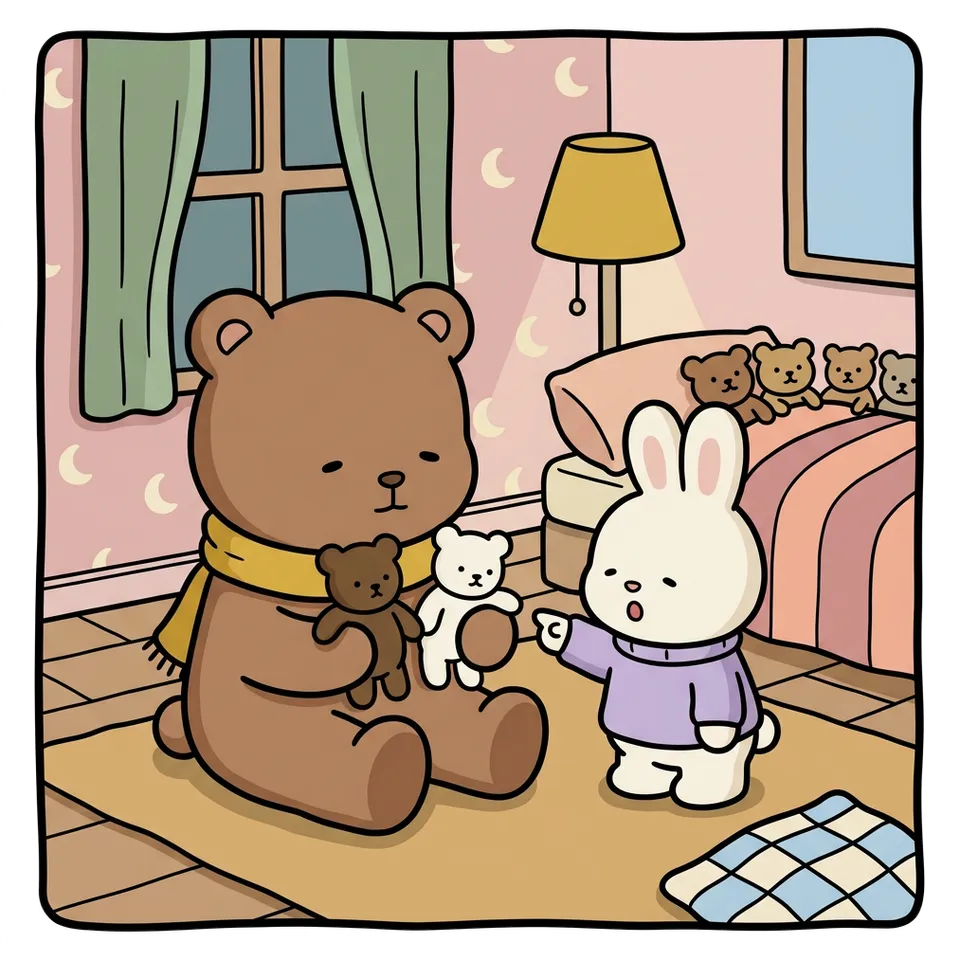
A role play of giving family names and roles to several teddy bears.
Why it's good
The child decides on their own who makes up a family and how. A name once given stays the same for days, but who plays which role changes from time to time.
How to play
The child doesn't forget the names given last time. A child came holding two teddy bears and said “This is the baby,” and the child next to them told them, “That one is Black Toli and White Toli.” To fill out the family there also had to be a dad, and the dad isn't a stuffed animal but a child. “Then ask Toli's dad,” one child said, and another child asked the child who had played dad last time, “Will you be Toli's dad?” I thought this family story would go on for a long time, but the answer was “I'm not going to do it anymore, I'm going to do other play.” The one who ended it was the child who had played dad.
Good to know
- Roles change at the child's whim. The stuffed animal that was dad yesterday is just a teddy today. When you're confused, ask “Who is this today?” The name the child answers is today's name.
- There are days when the number of stuffed animals suddenly grows. They arrive as gifts on holidays and birthdays, and come out of claw machines too. The day a new one arrives is a good day to start naming.
What you'll need
Two or more teddy bears (or stuffed animals)