Play Ideas with Shoes
When I say “Where are my shoes?” before we go out for a walk, the child picks their own out from the family's shoes mixed together at the entrance and brings them. But then they put a foot into Dad's shoes beside them, say “Big!” and laugh, and this time walk as Dad.
Shoes are things a child recognizes as their own, things they put on with their own hands, and things that turn them into someone else the moment they put them on.
This page was translated by Yeparksam, a preschool teacher in Korea. Some words may sound a little unusual — thank you for your understanding.
Printables to use
See more ›
Finding My Own Shoes
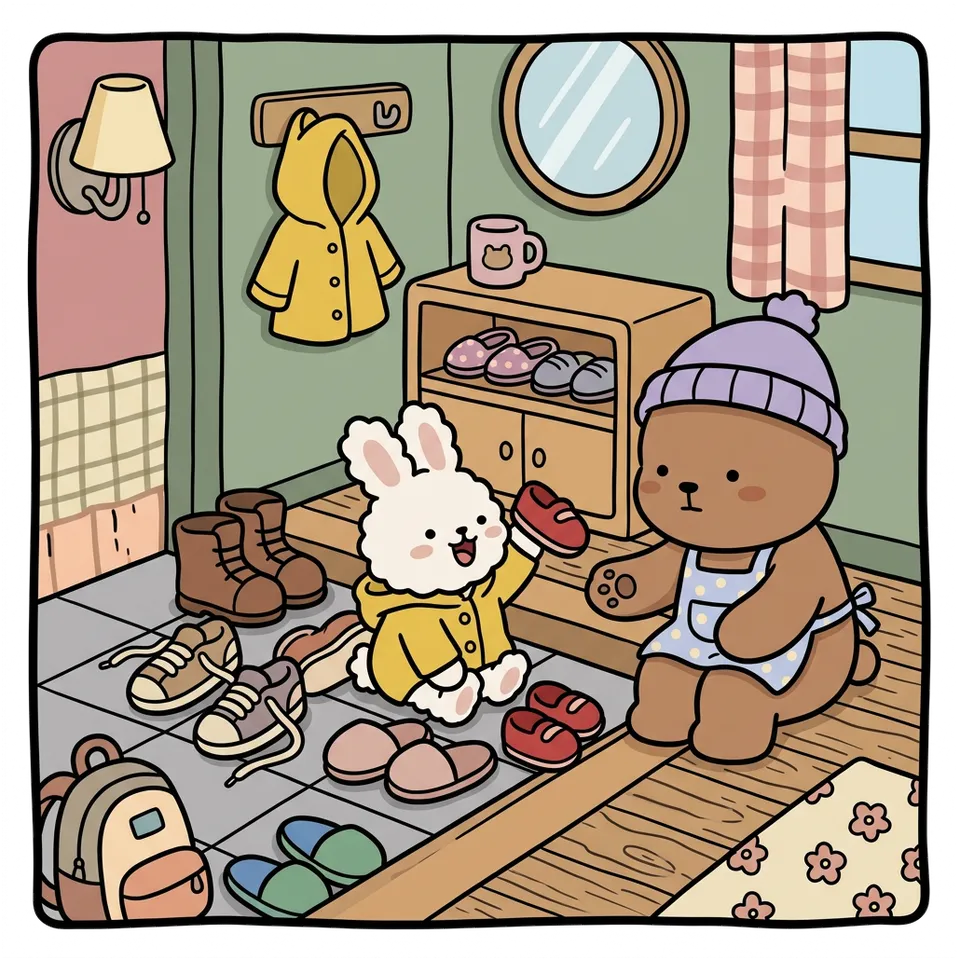
Find your own shoes among the family's shoes mixed up at the front door, and pick yours out from shoe photos.
Why it's good
Even when the family's shoes, different in size and color, are placed together, the child knows that one pair among them is theirs. Carrying them over, they also come to know that those shoes point to them.
How to play
At the entrance I said “Where are my shoes~?” and the child looked around among the shoes, found their own pair, and handed them to me.
When I took photos of the family's shoes, printed them, and spread them out, the child picked up their own photo and would not let go saying “It's mine.” When I held up the other photos one by one and asked whose shoes they were, they looked for a long time and then pointed to the family member.
The younger sibling looked at the white shoe in a photo for a long time. When I said it was white, they repeated “Wite,” and when I said “White like milk,” they said “Milk,” then stood up and lifted a foot, pretending to put on shoes.
If you mix in slippers of different colors, they try to match the same colors and put them on as pairs.
Good to know
- Print the family's shoes in the photos too. If there are only photos of the child's shoes, there is nothing to choose from.
What you'll need
Family's shoes · Photos of shoes (optional)
Putting Them On by Myself
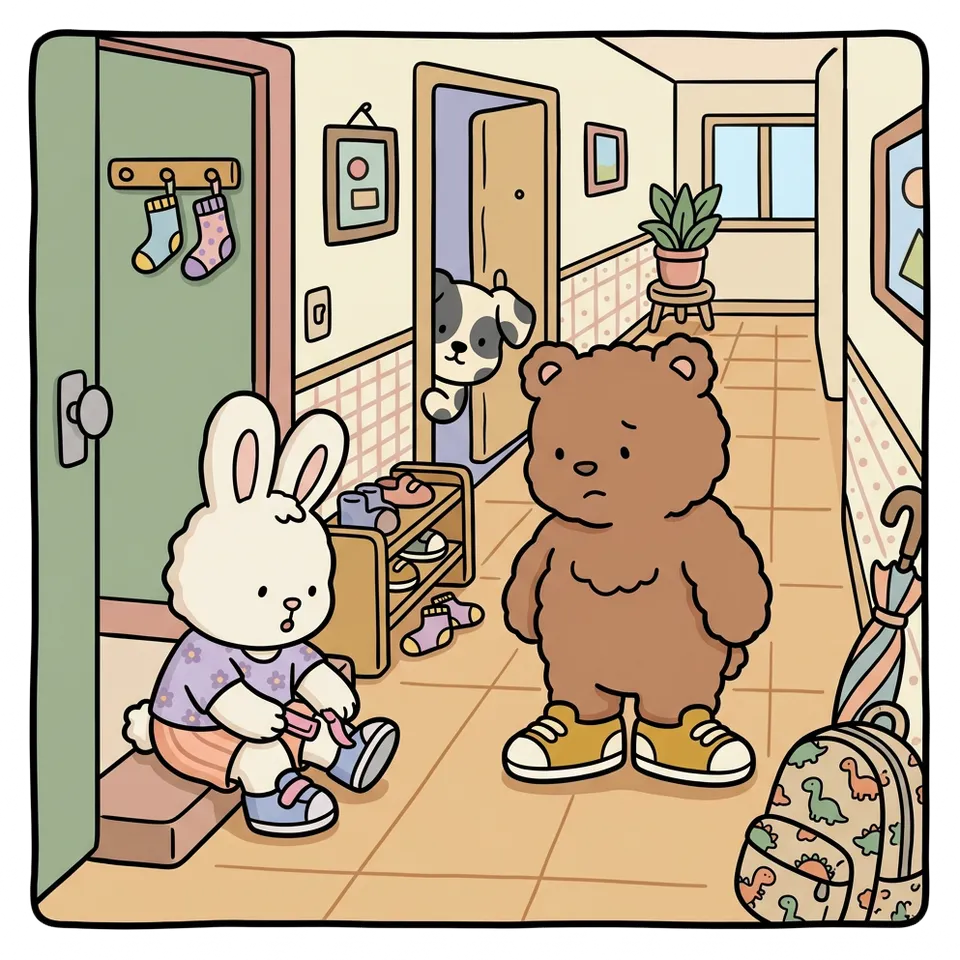
The child puts on and takes off shoes by themself, which an adult used to do. They put them on backwards and fix them, and put the shoes they take off into the shoe cabinet.
Why it's good
Shoes have a right and a left. Grown-ups who wear them every day forget this, but a child only learns it after walking in them backwards. Doing everything from putting on and taking off to putting away with their own hands, the shoes become theirs to take care of.
How to play
The younger sibling, who is just starting to toddle, brought over shoes that make a sound and held out a foot. When I put them on, they pulled them off with their hand in no time, then looked at me and laughed, asking to have them put on again. After a few steps, the squeak sounded and they stomped their foot, and they even tried holding the shoes up to their own foot.
The older child sat on my lap looking down at their shoes, and when I said “Shall we pull the Velcro and take off the shoes?” they pulled one Velcro strap off with a finger and then the other side too. When I said they take them off well on their own, they jumped up and wiggled their body. They put the shoes they had taken off in the shoe cabinet with their own hands.
On a day they set out to put them on alone, they sometimes put them on backwards. After walking a long while in the hallway, they took them off and said “These are backwards, I have to do them right,” and swapped them by themselves. They cannot yet tie sneaker laces, but perhaps having seen me tie them, they try hard to undo the laces and tie them again.
Good to know
- At first, Velcro shoes are better. Laces do not yet fit their hands, but Velcro they can pull off and fasten alone.
- If they put them on backwards, before fixing them, suggest putting both feet together. When worn correctly the toes of the shoes come together inward, and when worn backwards they spread outward, so even the child's eyes can see something is odd.
- Cut one sticker in half and stick the halves on the insoles of the two shoes. When the shoes are placed side by side and the picture matches, it is the right pair, so the child puts them on by themselves.
What you'll need
Velcro shoes · Shoes that make a sound (optional)
Trying on Mom's and Dad's Shoes
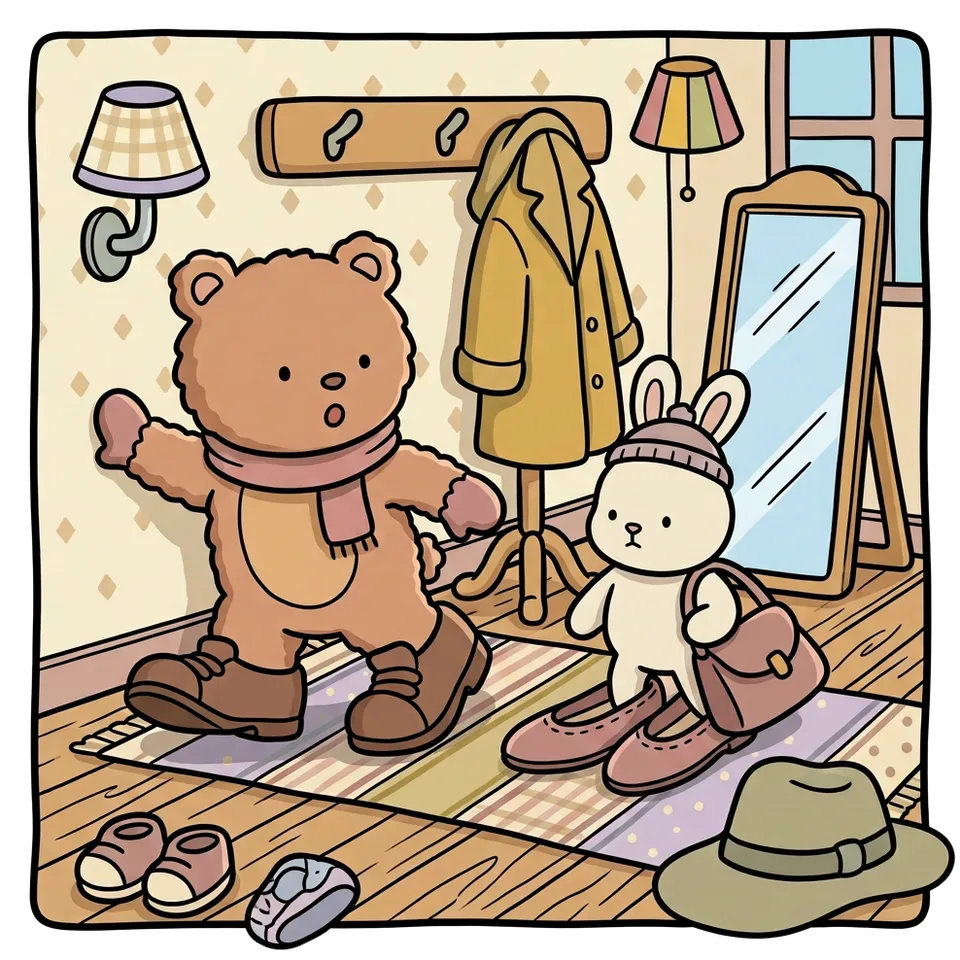
A role play where you walk in Mom's or Dad's big shoes and become Mom or Dad.
Why it's good
For a grown-up, big shoes are just loose, but for a child it means becoming the owner of those shoes. Wearing Mom's shoes they become Mom, and wearing Dad's shoes they become Dad, and even the way they walk changes.
How to play
When I took out the shoes from the entrance, the older child said “I'll wear Dad's dress shoes,” and the younger sibling said “I'll wear Mom's shoes,” and they each chose and put them on. When I asked how Dad's shoes were, they said “Big!” and laughed.
When I asked if they could walk, at first they walked with a hand on the wall, then took the hand off and said “I won't fall.” I worried they would fall because the dress shoes were so big, but they balanced step by step and walked very well.
The younger sibling held up a big shoe and said “This is Dad's~” then put it on and walked slowly saying “I'm Mom~” Every time their feet slipped around, laughter burst out, and they swapped shoes with each other and laughed again.
When I also gave them Mom's bag and Dad's clothes, in front of the mirror they said “I look like Mom.”, “I became Dad,” and they put on the bag and pretended to say goodbye and head out.
Good to know
- Leave out high-heeled shoes and slippery slippers. Big shoes make the feet slip around, so with high heels too it is easy to fall.
What you'll need
Mom's and Dad's shoes (low heels) · Mirror · Mom's bag or Dad's clothes (optional)