Play Ideas with Scarves
When I handed one over, the child didn't tie it around the neck. They covered their face with it first, pressed it up against their nose, and stayed still for a long while. I asked what they were doing, and they said, “It smells like Mommy, I think.” Then they never took it off and just wore it around — you can see right through a scarf even when it's over your head.
This page was translated by Yeparksam, a preschool teacher in Korea. Some words may sound a little unusual — thank you for your understanding.
Printables to use
See more ›
Peekaboo you can see through
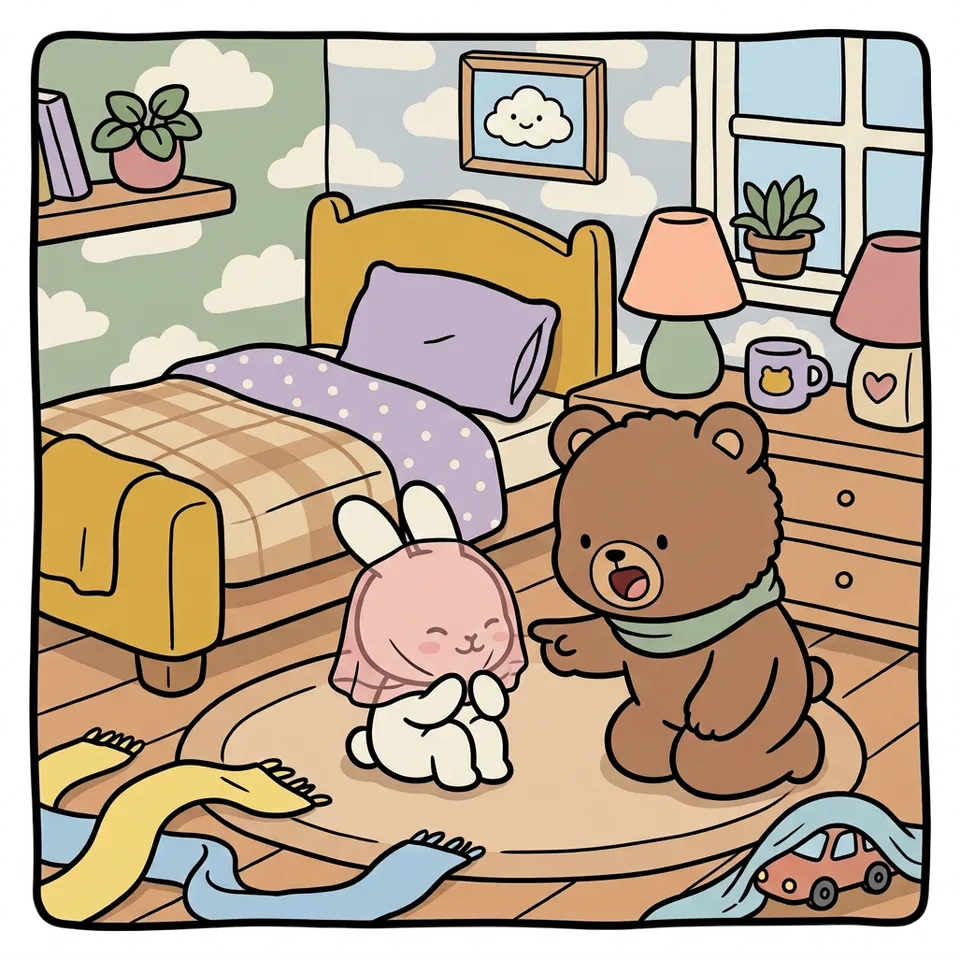
Lay a scarf over the child's face and the child pulls it off and meets your eyes in a game of peekaboo. The cloth is thin and see-through, yet the child still thinks they are hiding.
Why it's good
Why it's good: this play helps children understand the rule that if something is "covered," it counts as hidden, even when you can see everything. The child thinks they are hidden even though their face shows through, and the grown-up has to pretend not to find them for the game to work. This rule carries over from the face to objects held in the hand.
How to play
Lay a scarf over the child's face and wait. The moment the child pulls it off and our eyes meet, that's the peekaboo. After a few rounds, the child reaches out and covers themselves, and nothing gets hidden at all. A smiling face shows straight through the cloth, but they think they are hidden. If I ask where they went, their shoulders shake under the scarf.
The grown-up's job is to not find what is plainly visible. When I cover my face and ask where I've hidden, the child pokes me with a finger and says “Here!” and is delighted to have found me, even though everything shows. Then the child lays a scarf on my head and says “Peekaboo,” and when I asked where I'd gone, they lifted it off themselves and said “Here you are!” The child covered me and uncovered me too.
After the face, it moves on to things held in the hand. A child who had been shaking a block wrapped in a scarf hid it behind their back and said “Where's the block?~~~” even though you could see what they were holding. When I went around behind to grab it, they said “No, it's mine” and wouldn't let go.
Good to know
- A small cloth works better than a big one. If you can't make out the shape underneath, the child loses interest quickly. If you cover a toy car, it should make a car-shaped bump, so the grown-up has something to pretend not to find.
- It has to be a see-through cloth. If it isn't, covering the face really does make it dark, which is scary, and it won't work as peekaboo.
What you'll need
Scarf
Hanging them over a doorway
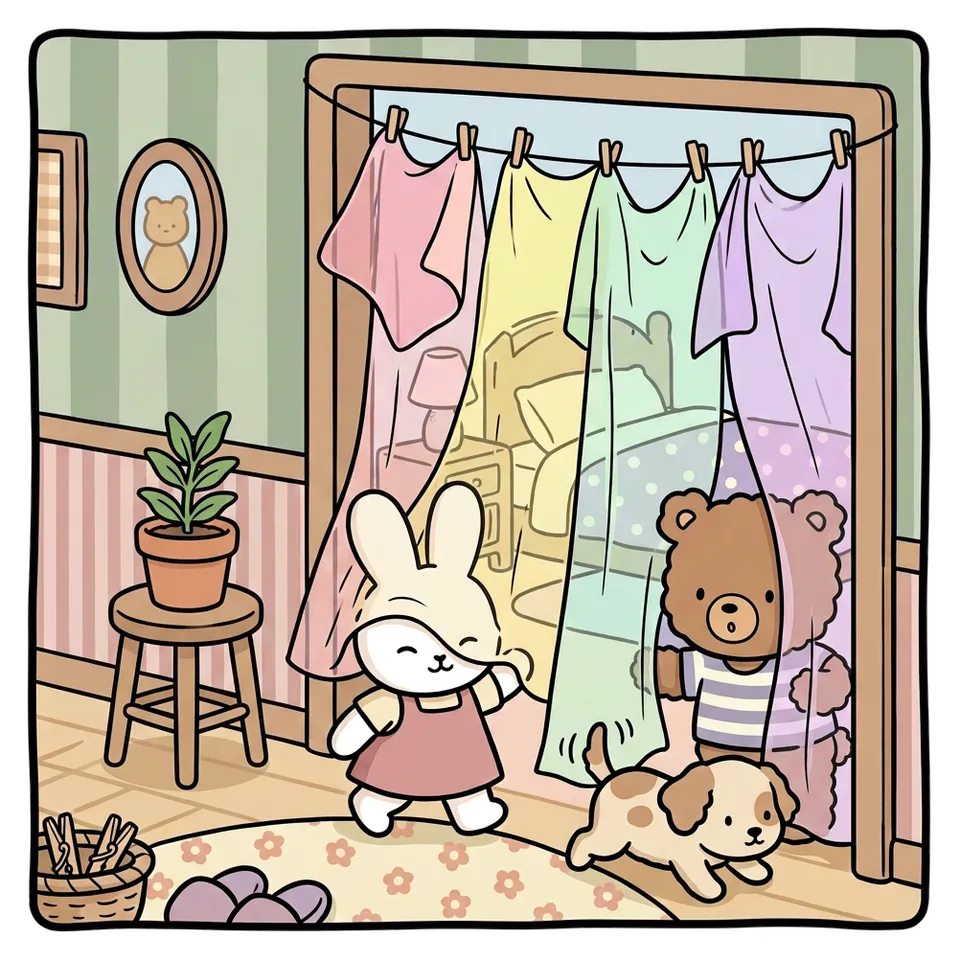
Tie a string across a doorway and hang several scarves from it with clothespins so they dangle. The child walks under them again and again, pushing through with their body.
Why it's good
Why it's good: the value of this play is that the child decides for themselves whether to be covered. Since no one is putting anything over them, they approach without fear and touch, and each child chooses their own way through — some run through, some crawl, some just poke out their face.
How to play
All you do is tie a string across the doorframe and hang several scarves from it with clothespins. A child who used to burst into tears when a scarf was put over their face and blocked their view came up carefully to this one and pulled at it with their own hands. Nobody was putting it on them.
Once it's up, they go in and out all day. They love the feel of it brushing their face as they pass. They don't push it aside with their hands. They go in head first, since the scarves are light enough to part with the head. Everyone has a different way of going through. Some run through fast, some crawl slowly on all fours, and some poke just their face out between the scarves and say “Peekaboo.”
I raise the string a little at a time. When what they could reach is out of reach, they stand on tiptoe. One child stretched out a hand to pull off a clothespin, couldn't reach, and tried blowing at it, “Pooh~” Then finally they grabbed the scarf with both hands and pulled it out from under the string. Pulling down what was hung up is part of the play too.
If you hang the scarves along a wall, the space behind them becomes the child's own spot. I once laid one over a tree branch outside, and a child went in under it, sat down, and said “This is the witch's house.” I asked if I could come in, and they said “No, it's our house” and wouldn't open up.
Good to know
- Tie the string higher than the child's height. If it's low, it can catch their neck.
- When several children come and go, pick one direction. Otherwise they bump into each other.
What you'll need
Several scarves · String · Clothespins
Stuffing into a tube and pulling out
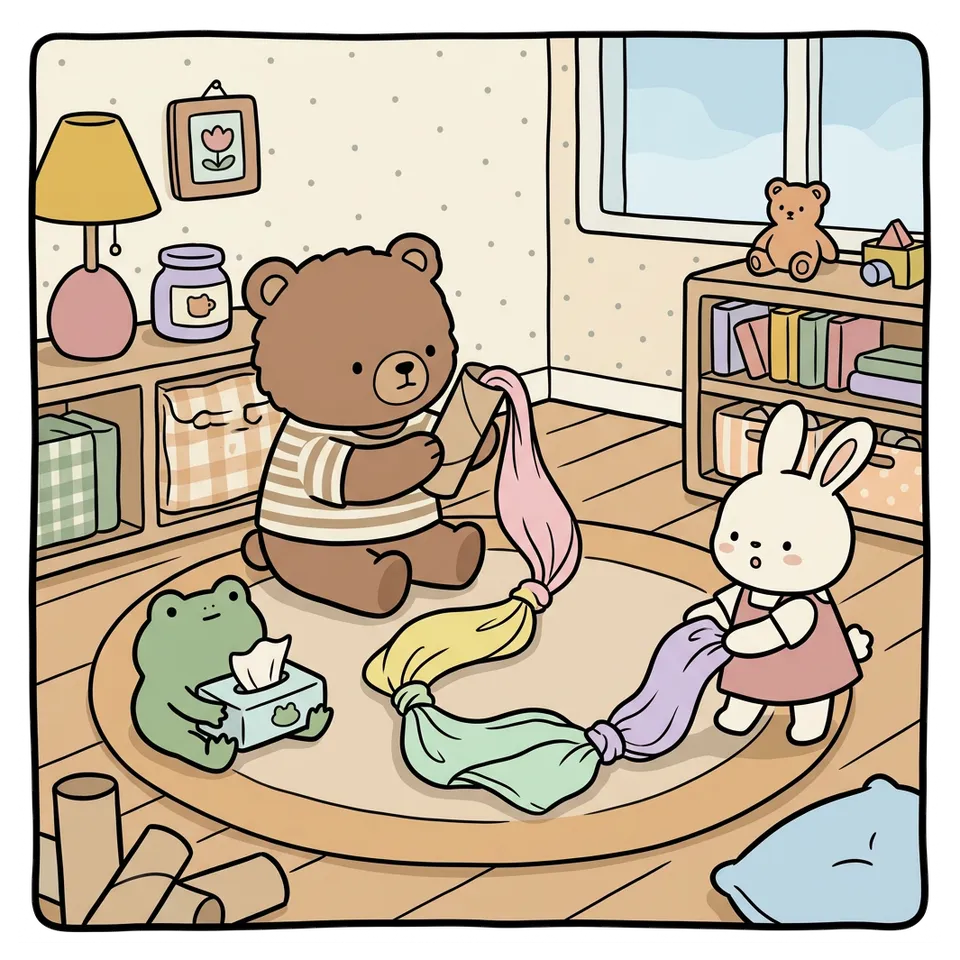
Push a scarf into one end of a tube, like a toilet paper tube, and the child pulls the end that sticks out to draw it out.
Why it's good
Why it's good: through their fingertips, the child checks how a big cloth they could see becomes small and disappears when crumpled in the hand. When you switch to a tube you can't see into, the child has to work out what they've grabbed by fingertip feel alone, not by eye.
How to play
I push a scarf into one end of a toilet paper roll and leave just a little sticking out the other end. The child notices that end first. They tug gently, then pull it all the way and it comes out with a “Swoosh.” Spread out, it covers a whole face, but crumpled it fits in one fist, so there's plenty of room for it to go in.
If you chain several together, it never ends. Tie corner to corner to make a long one, push it all into the tube, and leave only one end out. It keeps coming no matter how much they pull, so they open their mouth and say “Oh~”, then hold it in both hands, stand up, and back away to measure how long it is. When it's all pulled out, it turns into tug-of-war. If I hold one end and gently let them win, they want to do it again and again.
Switching to a tube you can't see into opens up another round. A toilet paper roll is open at the other end, so you can see all the way through. With a closed tube, you have to put your hand in and feel around, and if you still can't grab it, you put your whole face up to the tube and peer in. Then they pull it out without knowing what they've grabbed and name the color first. “It's a yellow scarf,” they say.
Good to know
- Any tube will do. An empty wet wipe container, a plastic bottle, or a box with a hole cut in the lid all work.
- A grown-up helps with the putting in. Their fingertips aren't strong enough yet to push it in alone. If the child brings one to try, I rest the end at the hole and let the child do the pushing.
What you'll need
Several scarves · Toilet paper roll · Tube you can't see into
Waiting underneath to catch
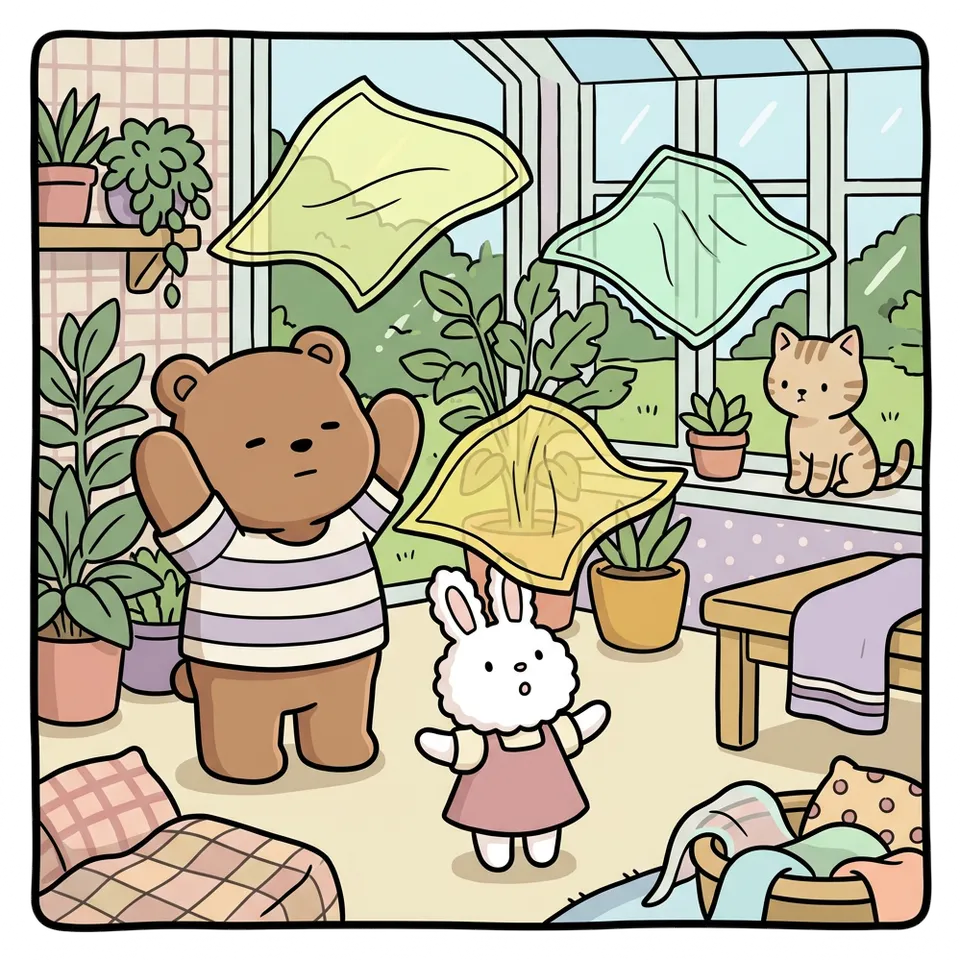
The adult throws a scarf up high, and the child waits underneath and catches it.
Why it's good
Why it's good: even a child who can't catch a ball can catch a scarf. While it drifts down slowly, there's time to get into position underneath and open their hands, and at first catching it with the face instead of the hands is quite enough.
How to play
I do the throwing and leave only the catching to the child. When the child throws it alone, it doesn't go higher than their own height, and they look at me. Then I throw it for them. Splitting the job that way, we pass it back and forth many times.
A ball drops right at your feet, but a scarf hangs in the air for a long time. In that time, the child runs under it, spreads out both hands, and waits. At first they catch it with their face instead of their hands, and they still love it.
If they wave their hands to grab it, it gets away. The swinging arms make a breeze that pushes it sideways. Since they kept missing, I told them to just hold their hands open and stay still, and it simply landed on their palms.
If they hold one in each hand and throw both at once, their eyes get busy. They threw them the same way, but the two come down differently. Their head swings back and forth to see which one lands first.
Good to know
- Since children run around looking only up, cover the corners of low tables. Lay one towel over them and the children can chase it without worry.
What you'll need
Several scarves
Stepping on it and being pulled like skates
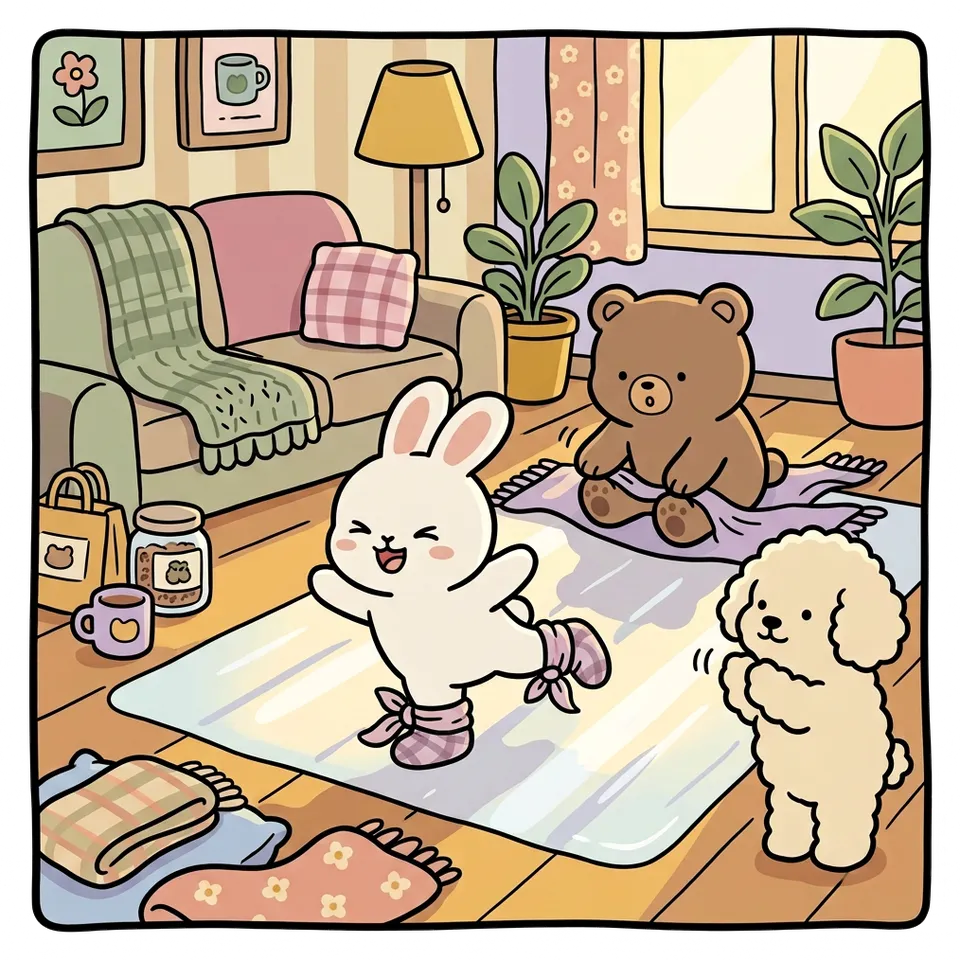
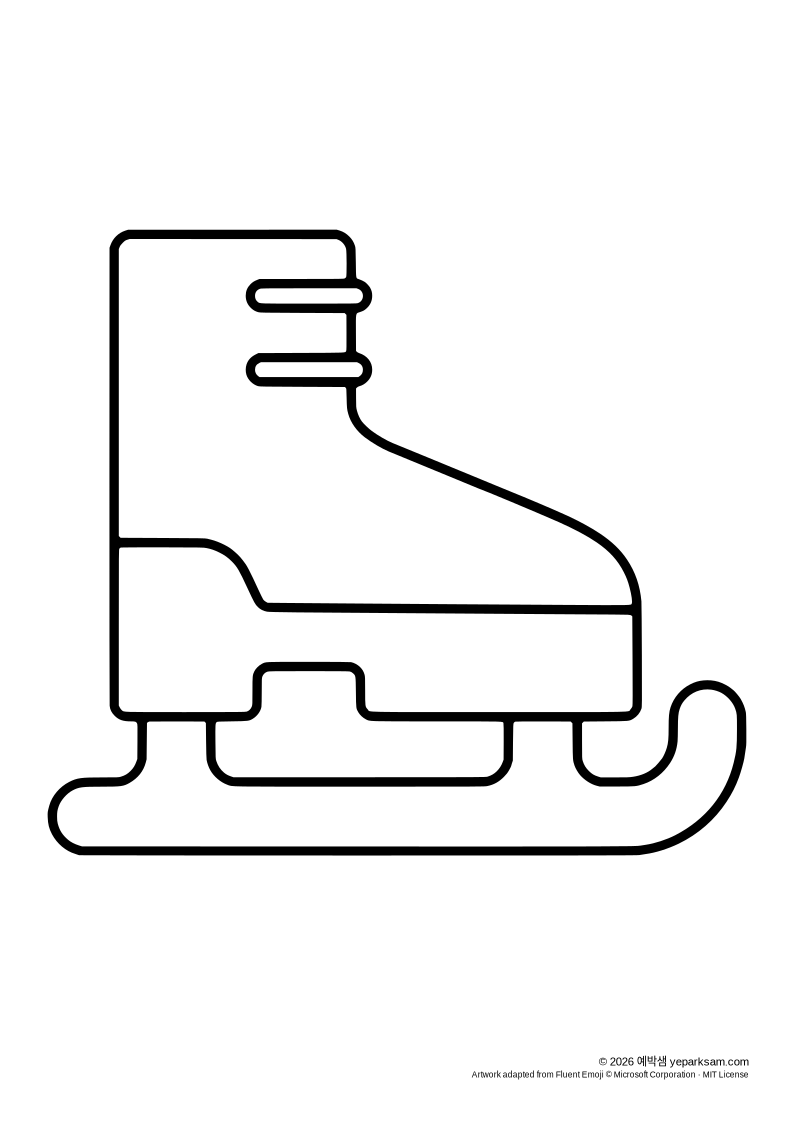
Spread a scarf on the floor and stand on it to slide. The ground is slippery under the feet, so pushing the legs back and forth makes you glide like skating.
Why it's good
Why it's good: this play is where children discover for themselves which floors are slippery. As they balance and push with the left foot and the right in turn, they notice on their own that they slide especially well on a shiny spot. They find out how the floor differs from place to place before the grown-up does.
How to play
Spread one on the floor and stand on it, and your feet slide. A child who had been pushing their legs back and forth said “Look! I'm skating~!” and then “Hey everyone, look at me” and called the other children over. If I ask what they're doing, they brag, “I'm skating. It's super slippery and fun.”
If they just stand on it, their feet keep slipping out. If I wrap it once around the top of the foot and tie it, they start pushing along, left foot, right foot. All I do is tie one knot, but the moment it's tied they say “This is really like skates.”
The next part is fun. A child sliding along passed a certain spot and shouted “It's super slippery here! Come here!” It was a shiny patch of floor. “It's sparkly, so it's just like ice,” they said, spinning around right there, then lifting one foot to imitate a figure skater. After that, they only went to the slippery spots.
If they slip while standing, I sit them down. I told a child who almost fell to try it sitting, and they sat right down and pushed off with “Here we go~!” If I hold one end and pull slowly, they feel their whole body sway.
Good to know
- If they almost fall while standing, have them ride sitting. When the skates turn into a sled, there is no falling.
- Wrap it once around the top of the foot and tie it so the foot doesn't slip out. If they just stand on it, the foot keeps slipping out.
What you'll need
Scarf
Wrapping up and looking in the mirror
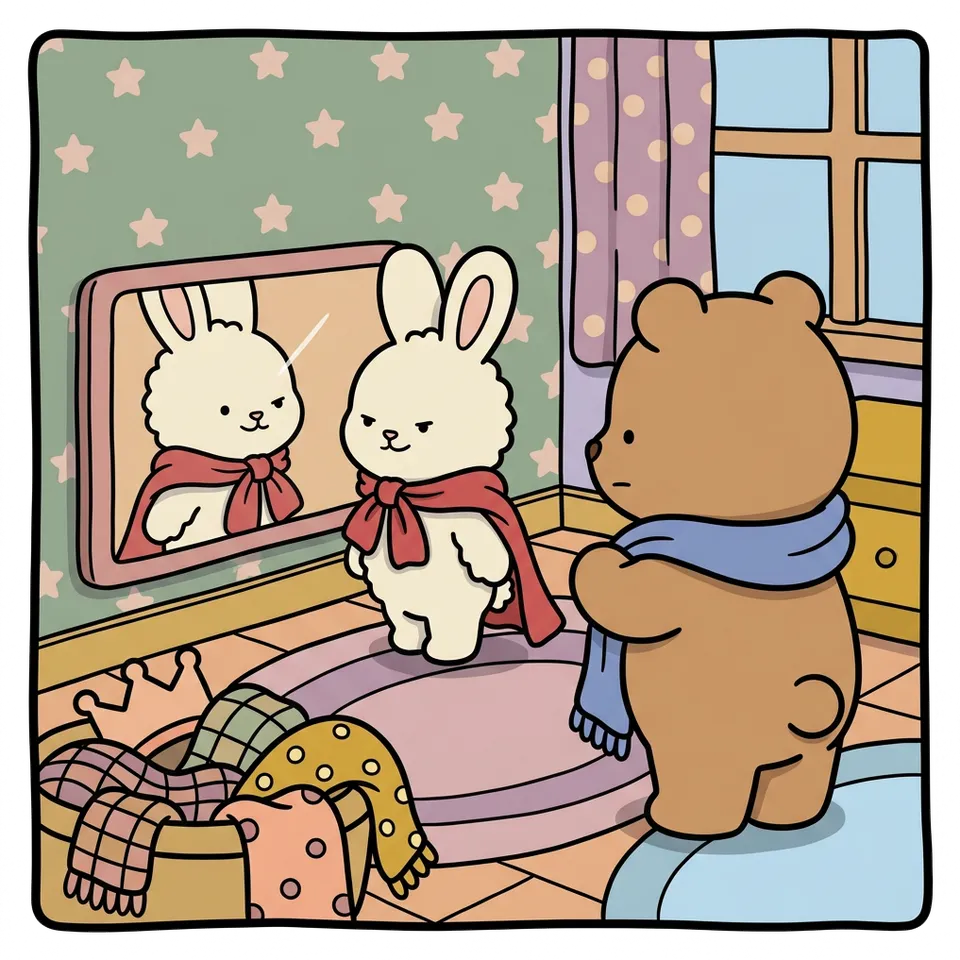
Tie a scarf around the neck, shoulders, or waist and stand the child in front of a mirror. The child walks to the mirror on their own and looks at themself all wrapped up.
Why it's good
Why it's good: the heart of this play is not the wrapping but seeing yourself wrapped. Without a mirror, children take it off again soon after putting it on, but once they stand in front of a mirror, they can't just walk past.
How to play
Tie it once around the neck, and from that moment it's a cape. A child carried a big one over, held it up to their neck in front of me and said “Ooh~”. I asked if they wanted me to tie it, and they nodded. When I made the knot, they spun around right there, then spread their arms and circled the room several times.
They can wrap it themselves, but tying it behind the back is too hard. So for this play alone, they call me. When they run, it comes loose, and when it does, they come back and silently turn their back to me. There are days I tie knots all evening. It isn't only around the neck either: some children want it on their head, some over their shoulders, some wrapped around their waist, and each comes separately.
Standing them in front of a mirror is what completes the play. Without being asked, they walk up to the mirror, look at themselves for a long time, and grin.
Good to know
- Tie it loosely at the neck, and only while you are watching. Hang it once from behind and leave the ends long, so it comes undone if the child pulls.
- The mirror has to be at the child's eye level.
What you'll need
Large scarf · Mirror at the child's eye level
Being a jellyfish
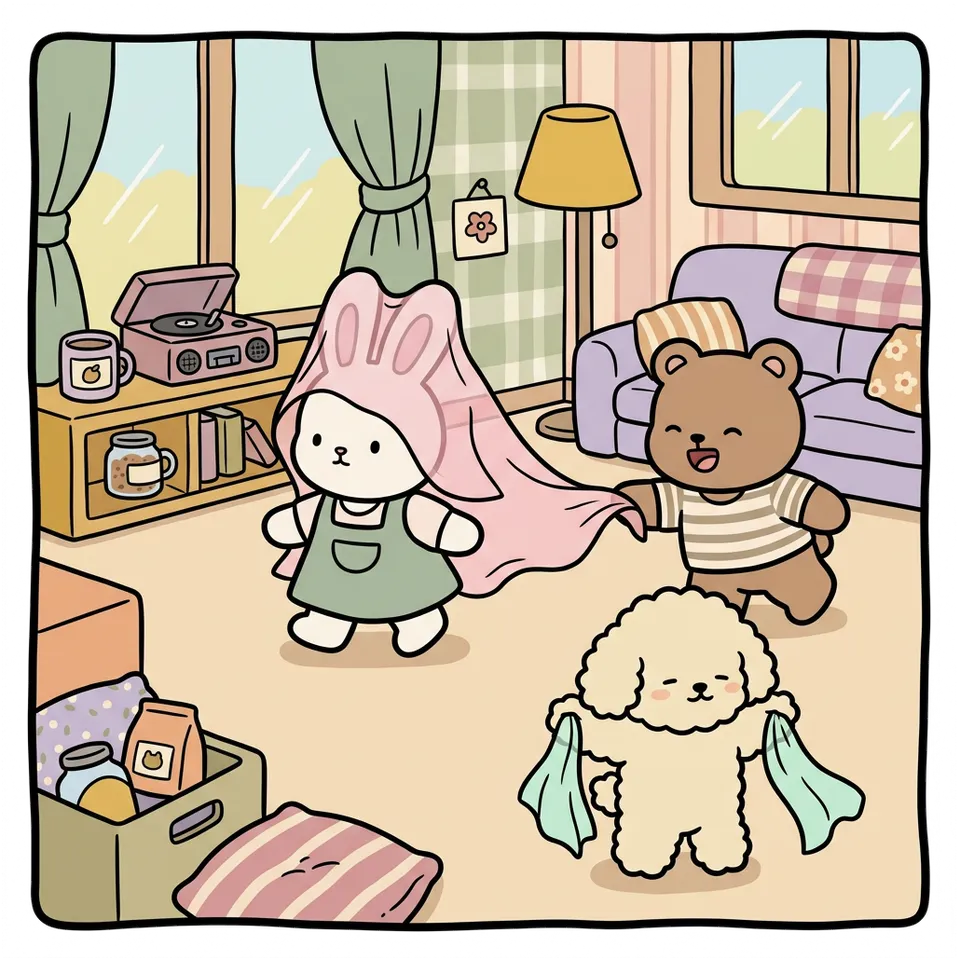
Walk with a scarf on your head, or hold one in each hand and sway your arms like a jellyfish.
Why it's good
Why it's good: this play lets children see with their eyes the movement they can't see with bare hands. When they swing an arm, the scarf's ends follow a beat later, so the path the arm took becomes visible, and when the tempo of a song changes, the child adjusts the movement on their own. I never taught it, but the single word "jellyfish" slows their steps down.
How to play
Put one on your head and walk, and you're a jellyfish. The way it floats and trails behind looks just like one. One child put it on, wobbled their body loosely, and said “The jellyfish is moving.”
Once they're a jellyfish, they go straight into a game of tag. That child went up to a friend and said “Catch the jellyfish,” and the friend grabbed the dangling end, pulled it, and said “Peekaboo!” Both the one being caught and the one catching want a turn, so they keep switching places.
If they don't want it on their head, I hand them one for each hand. When they swing their arms, those become the jellyfish's legs. If I flap big first, the child's head follows.
If you put on a song the child likes, it lasts much longer. When it slows down, they swing their arms softly and say “Slow~”, and when it speeds up, they shake energetically and say “Fast!” One child said “I want to do it again!” when it was over.
Good to know
- Clear away anything lying on the floor. Once they are jellyfish they soon move on to tag and run across the room.
What you'll need
Scarf
Tucking in, then lying down yourself
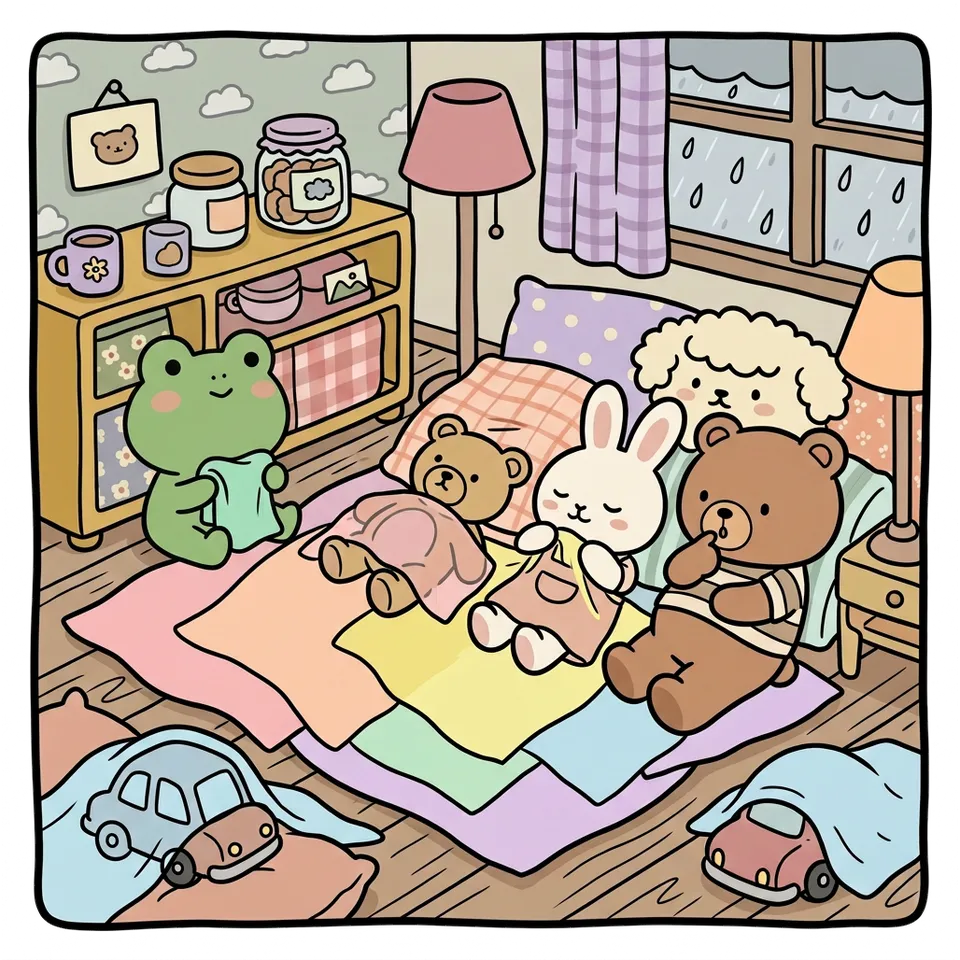
Lay a doll down and put a scarf beside it, and the child covers the doll and pats it. Stacked up, the scarves become a bed, and the child sometimes lies down on it too.
Why it's good
Why it's good: in this play the child chooses what to put to sleep. They do for themselves exactly what they did for the doll: they put the doll to sleep, lie down beside it, and cover their own body with a scarf too. The hand that cared for someone else carries over to caring for the child themselves.
How to play
Lay a doll down with one scarf beside it, and the child covers it on their own. The size is just right. They spread it, cover the doll, pat it, and say “Zzz~ sleep,” but one scarf leaves the feet out. They notice, bring another, and lay it over the feet. Some children cover a toy car with two scarves, pat it, and say “The car is sleeping.”
Stack several and they become a bed. One child piled them neatly on the floor, said “I'm making a rainbow-color bed right now,” and climbed on top to lie down. They put the doll to sleep, lay down beside it, covered themselves with a scarf, and said “I'm a baby too~” A child nearby said “I want to be a baby too!” and lay down after them.
On rainy days they don't get up from there. A child lying covered, listening to the rain, said “It's like real rain! Close your eyes and listen!” and then “It's sleeping time, so we have to talk quietly,” and lowered their voice.
Good to know
- I actually don't use real blankets. They're heavy, and sometimes a child's hands can't spread them out.
- The child chooses what to put to sleep. It could be a doll or a toy car.
- Gather ones that are all different colors. Stacked up, they become a “rainbow-color bed.”
What you'll need
Several scarves · Doll