Play Ideas with Blocks
Dolls have faces and cars have wheels, but a bin of blocks tipped onto the floor is still nothing yet. Play begins the moment a child calls it something. Until then, it's just pieces of wood and pieces of plastic.
Blocks look like something a child plays with alone. You'd think you could pour them out and step aside, yet this is the play I get called into most often. Only the child knows what the thing they built has become. From the side it's just stacked blocks, so the child has to tell you.
When I go over, what they ask of me is different every time. Nothing grand, either. The child decides, and once they've decided, there turns out to be a small part in it for me.
This page was translated by Yeparksam, a preschool teacher in Korea. Some words may sound a little unusual — thank you for your understanding.
Printables to use
See more ›
Stack It and Knock It Down
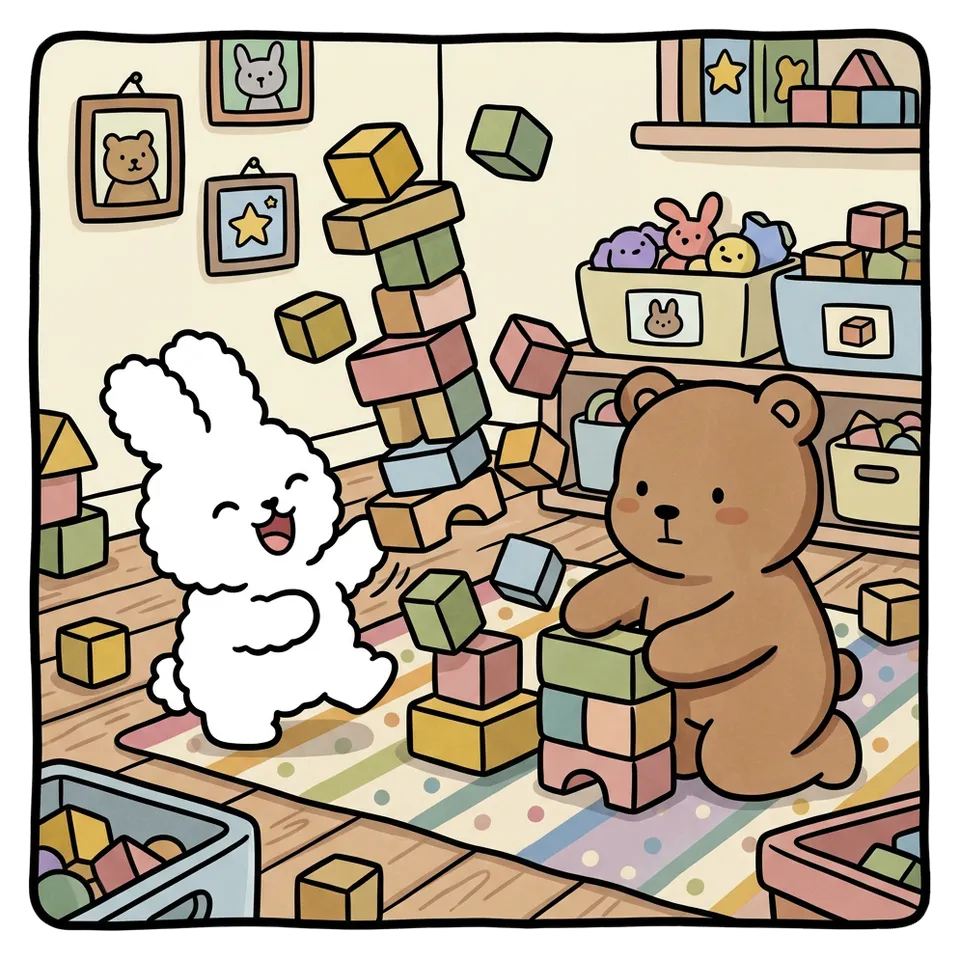
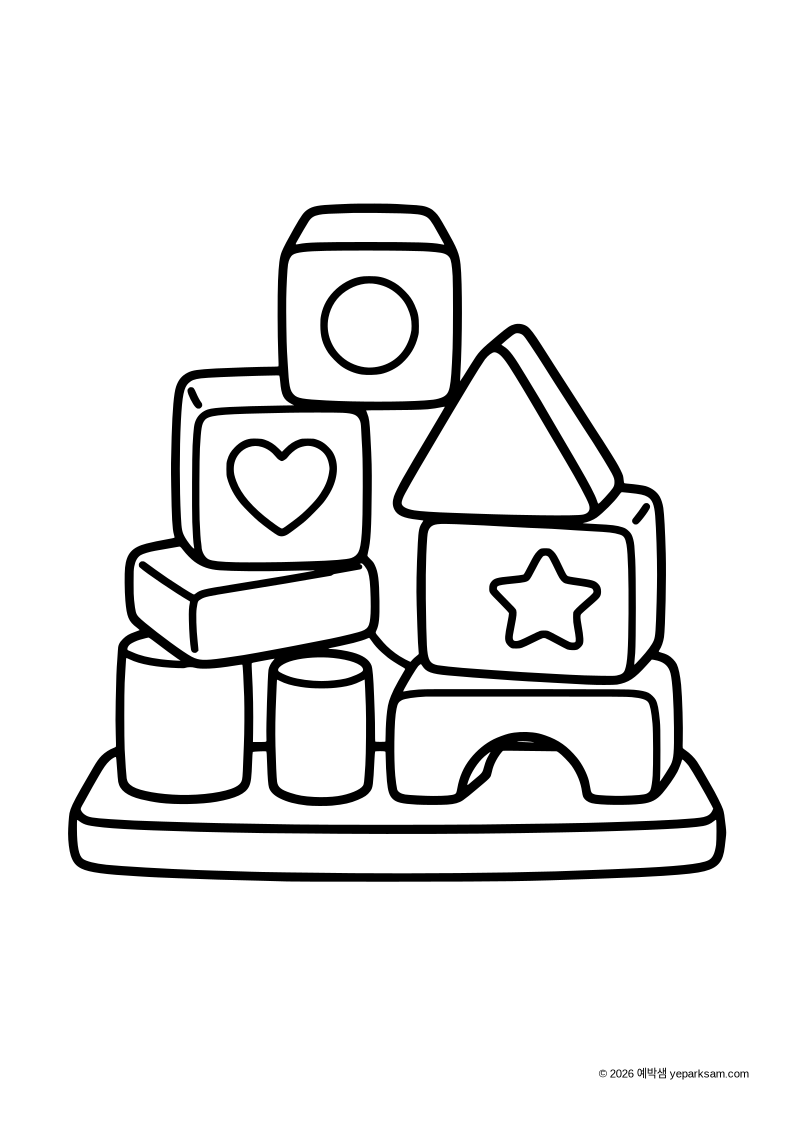
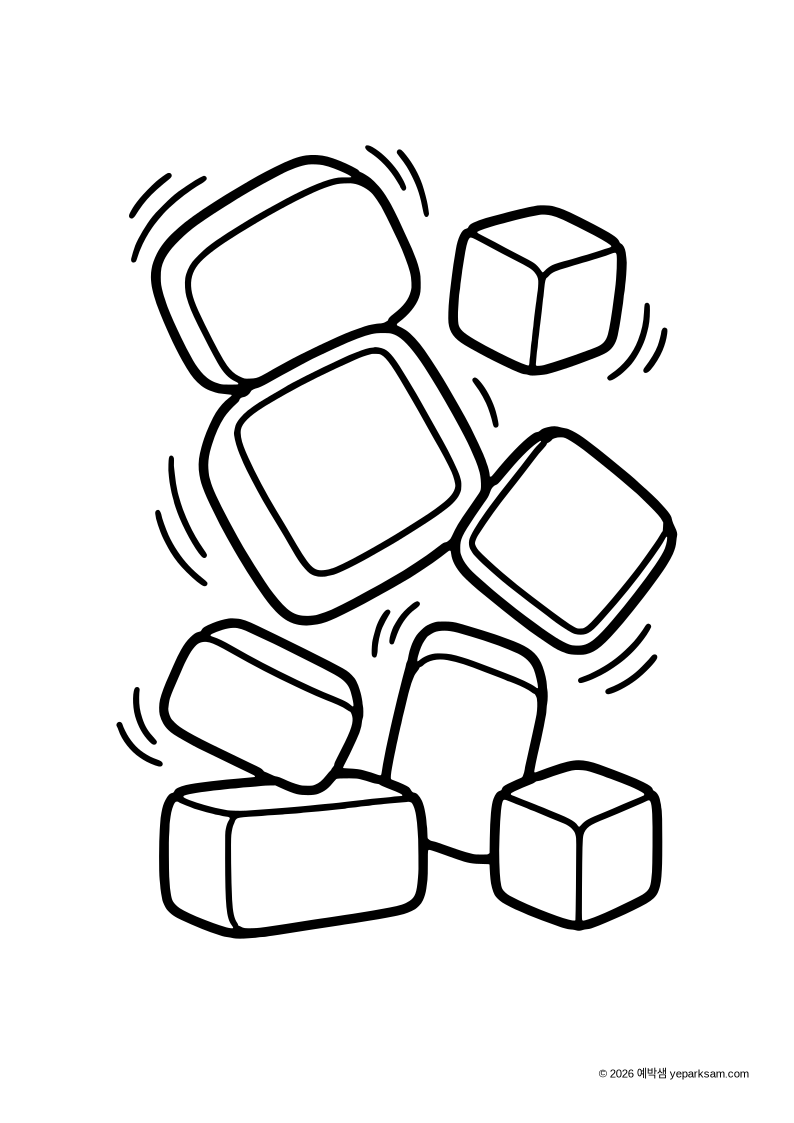
Stack blocks up high, then sweep them down with your hand.
Why it's good
It's play where children learn with their bodies that a knocked-down tower is no big deal because you can just build it again. If you add only a little help and leave the rest to the child, the tower becomes their own, and they want to build another one beside it.
How to play
For a while I built them with great care. I'd match colors and shapes, stack them high, and show off with a "ta-da," and the child would sweep a palm across and knock it all down like they'd been waiting for it. Then they'd burst out laughing and say “Again, again!” After that I stopped being careful and just stacked fast.
Soon the child starts stacking on their own. They go up on tiptoe trying to build higher than their own height, and when it wobbles, they call me. That's when I only hold the bottom. If I stack the top too, it seems to stop being theirs, and the child lets go and wanders off. When I only steadied the bottom, the child finished one whole tower and started another beside it. “I make two houses.” All I did was press down the bottom couple of blocks with my hand, but without that hand, a tower their own height doesn't stand well.
There's one way to move on without knocking it down. Lean a tray at a slant against what you've stacked and it becomes a slide. I rolled a ball down and the child said “Fast!” in surprise, and from then on raised and lowered the tray again and again, rolling the ball over and over. Fetching the ball that rolls away is part of the play too, so I just get to sit.
Good to know
- Building many times beats building well. At the age of calling "again, again," quickly stacking and knocking down over and over keeps them playing longer than carefully matching colors and shapes.
- Pressing down the bottom couple of blocks is enough. If you stack the top for them, it stops being theirs and they let go and leave, but if you only steady the bottom, the tower stands up to their own height much better than it would without that hand.
What you'll need
Blocks · Tray · Ball
Build a House and Keep the Wolf Out
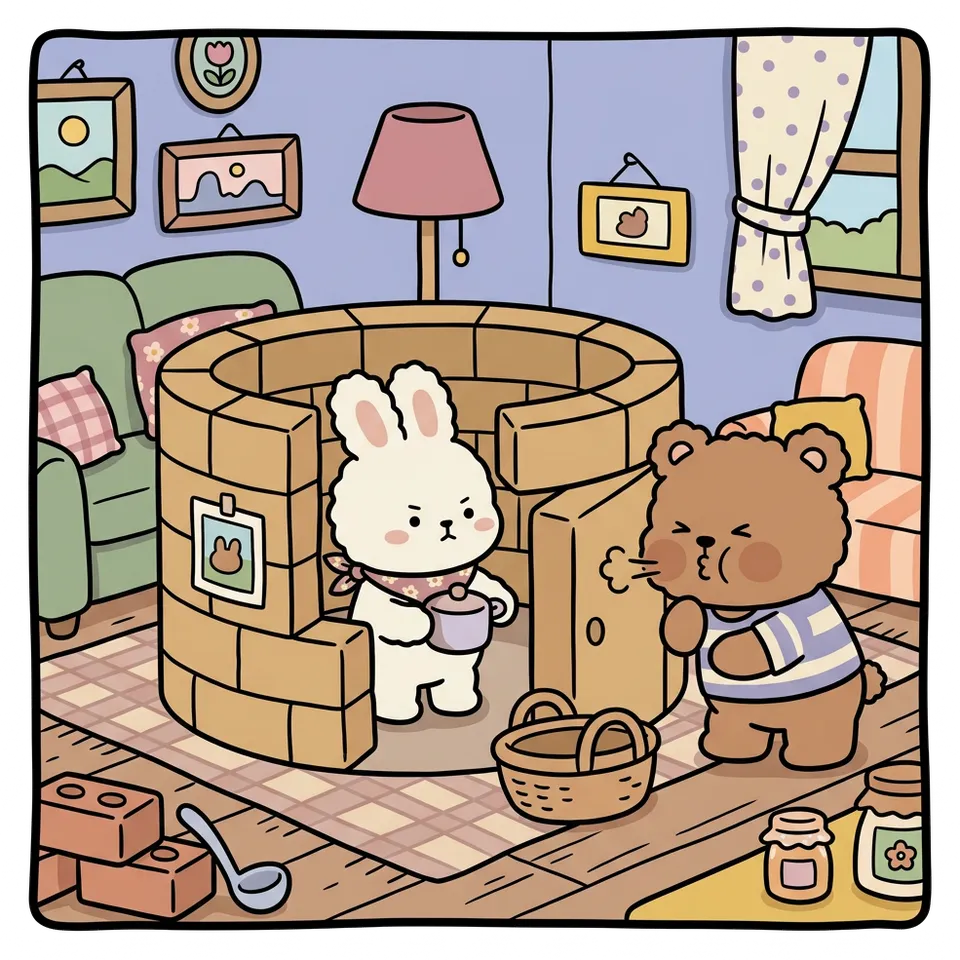
Build a house by setting big blocks in a circle and play going in and out through the door.
Why it's good
It's play where the child decides who gets to come in. Their mind is more on choosing who comes through the door than on raising the walls, so even if a grown-up asks to come in, whether to open the door is the child's call. Children also find ways to keep the wolf out without anyone teaching them.
Books to read together


How to play
Just setting big blocks in a circle makes a house. It doesn't need a roof. They play for a good while just going in and out of the open space, and soon they start with the door. Move one block aside and that spot is the door. When they told me to come in, I asked where I should go in, and a child tilted one block open for me. One day a child left me standing outside, saying “There's no door here so you can't come in.”
If I really go in and sit down, it usually collapses once. When one person goes in, siblings and friends who came over all follow. The inside fills up and the walls get pushed out, but the children just said “It's okay, we can just build it again,” and started rebuilding. I was the only one who minded.
After that, sitting outside the door gives me a job. The wolf. Build a house with brick blocks and the Three Little Pigs come along on their own. Some children see a tumbled stack and say “I think the wolf came” first. When I wave my hand outside and huff and puff, they pretend to shiver inside, then wave back saying “You can't come in!” When I made a move as if to come in through the door, the children brought out a pot and started boiling water. I asked what they were doing and they said “Boiling water. Wolf come in, go in water.” I only waved my hand outside, but the ending came from the child.
If the wolf can't get in, it sometimes becomes someone else. One child said “I'm not going inside the house,” then brought a basket, set it down at the door, and said “The wolf delivered a package.”
Good to know
- The child decides whether to open the door. If a grown-up tries to come in and the child blocks them, just wait outside.
- The grown-up's place is outside the door, not inside. If you sit inside, it gets crowded and usually collapses once, but the children don't mind and start rebuilding.
What you'll need
Big blocks · Brick blocks · Pot · Basket
Crossing the Stepping Stones
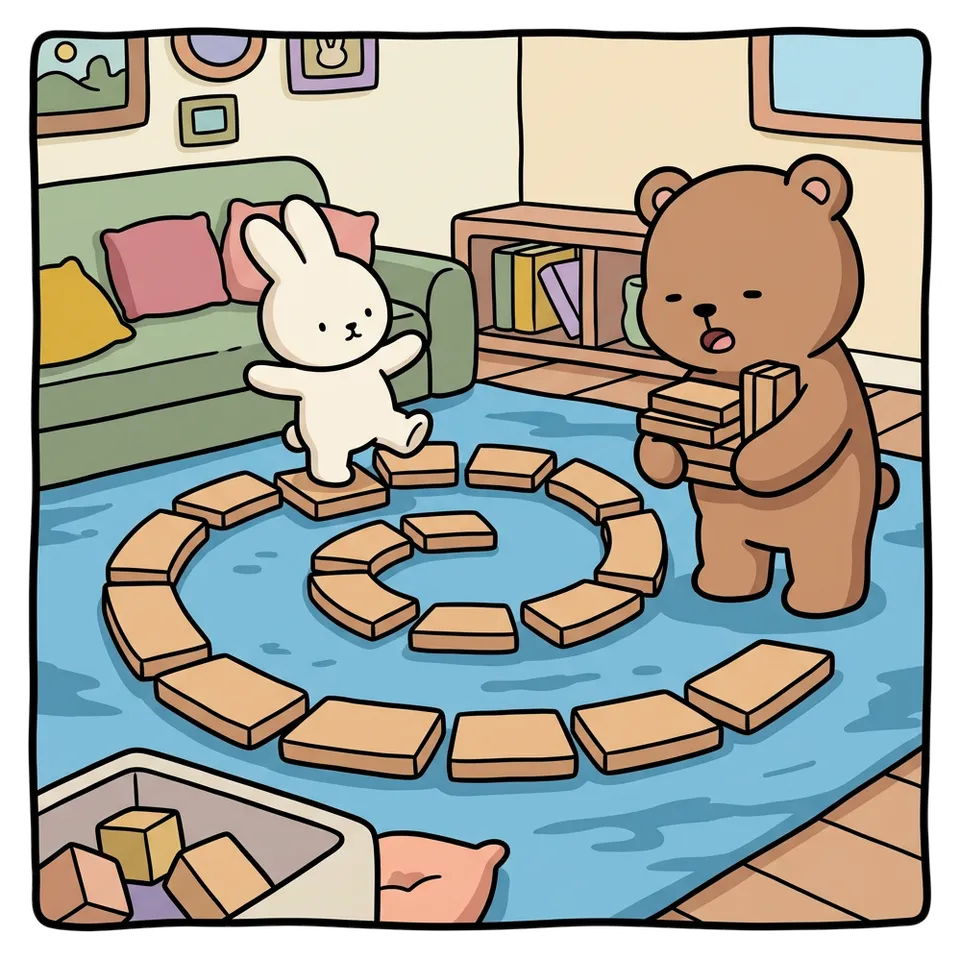
Set blocks down one at a time with gaps between them and step across on top of them.
Why it's good
It's play where children watch where they put their feet and adjust their steps. On a low path with the blocks pressed together, they pass without looking down, but when there are gaps they have to look to see where the next foot goes, so they hold out their arms for balance and slow down.
How to play
If you line blocks up end to end, the child steps up and soon steps down again. Only when you pull them apart one by one does it become crossing play. When they've crossed, I add one more block at the end. The path they thought they'd finished stretches out again, so they come back and cross once more. After a few rounds, they go to the bin and start bringing blocks to add on themselves. From then on, the child decides the length.
The path doesn't have to be straight. Once I curled it inward like a snail, and it took a long time to reach the middle. One child said “Outside here is the sea, don't fall in!” and a child nearby brought more blocks and said “Then let's do this so we don't fall,” and joined the path together. The child who posed the problem and the child who solved it were different children.
A child who has really crossed stepping stones talks about it. When I laid out the path, a child said “Stones, they're stones!” and when I asked where they'd seen them, said “I went with Mommy.” Play brings along the places they went that day.
Good to know
- Lay them in a single layer only. Since children step up onto them, crossing over a stack is dangerous if a foot slips. With one layer, a slip just means stepping down.
- Put them on a carpet or mat. Stacking needs a hard floor, but this play is the opposite: the blocks must not slide when stepped on.
What you'll need
Blocks
Build a Train and Set Off
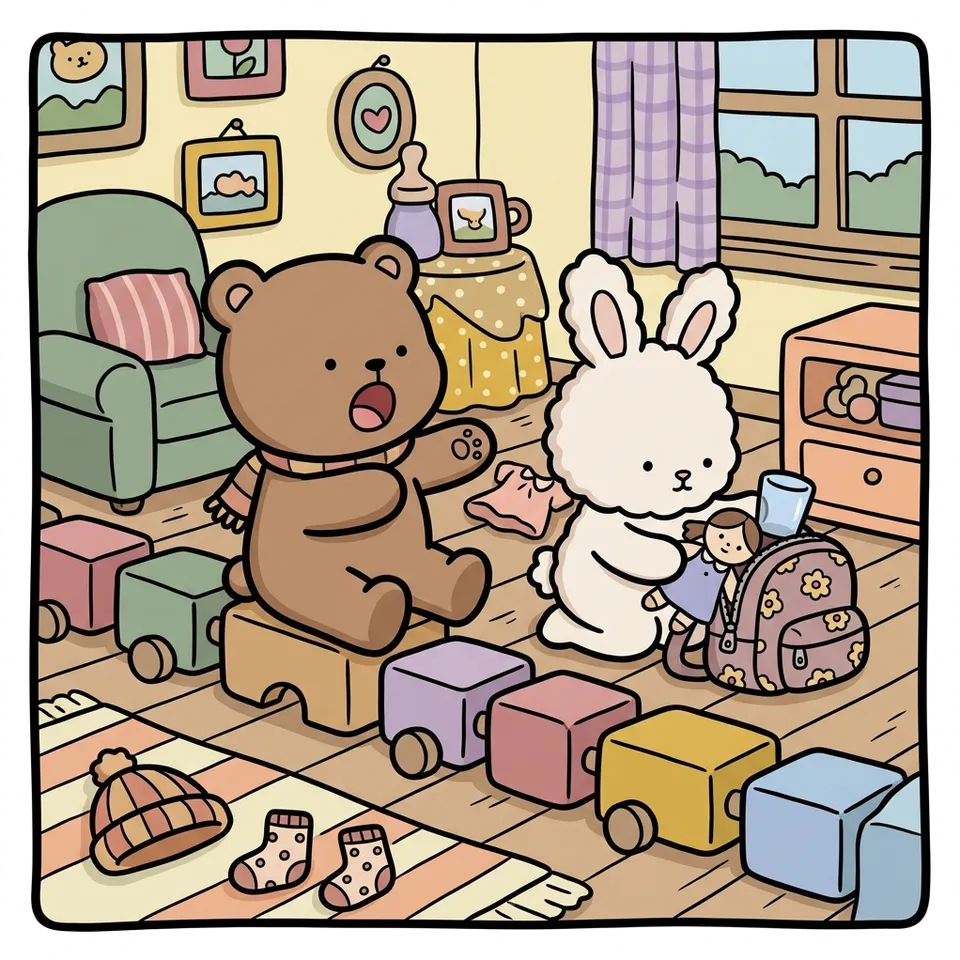
Link blocks in one long row to make a train, then decide where it's going and pack the bags.
Why it's good
A train that doesn't move becomes a real train with a single word, "going." In choosing where to go and packing, children carry over the very order of getting ready that they go through every day.
Books to read together


How to play
Link blocks into one long line and it's a train. I used to think making it was my whole job. But once I'd linked it all and sat the child down, they'd sit and stand a few times and that was it. I thought they'd lost interest because it didn't roll, but that wasn't it. The line becomes a train only when there's somewhere to go. The child at the front said “I'm going on a trip!” Until those words come, it's blocks on the floor, and once they do, it's a train even without moving.
Once the destination is set, they need luggage. I found a bag and handed it over, and the child began searching the whole room. They put in a doll saying “Need it,” put in doll clothes saying “Wear it,” and dropped in an empty cup saying “It's water.” I was a little surprised that doll clothes came after the doll. They had carried over, exactly, the order of their own mornings.
The train stays put while the child circles the room several times. It's tempting to link on more cars, but it's better to just hold the bag open and wait. Getting ready taking longer than leaving is something grown-ups know too, isn't it?
Good to know
- If the child doesn't say it first, just ask where they're going. The line becomes a train once there's somewhere to go. I asked if it was the playground, and one child said “Grandma's house!” and decided again on their own.
- Give them a bag with a zipper or buttons. At this age opening and closing is play in itself, so they get one more round of play out of fastening it after packing.
What you'll need
Blocks · Bag · Doll
Turn Magnet Blocks to Make Them Stick
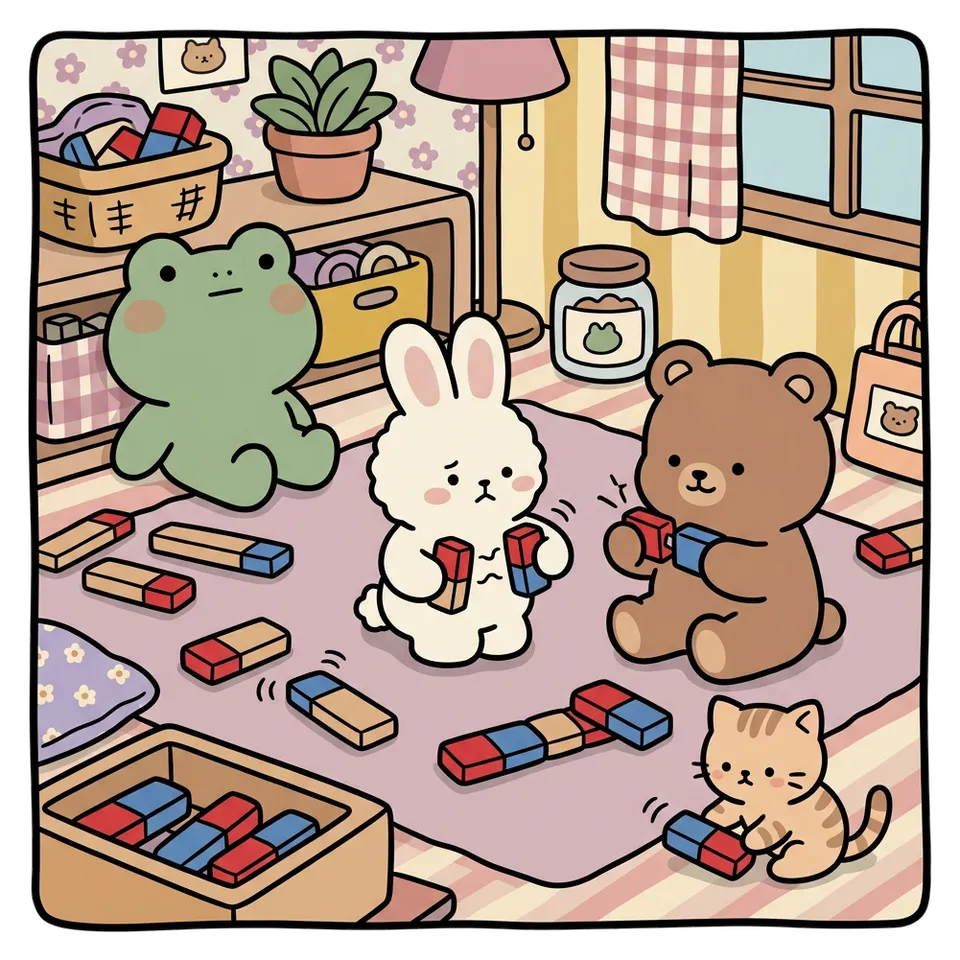
Stick magnetic blocks together and pull them apart, and when a block pushes away, turn it around to find the spot where it sticks.
Why it's good
What holds a child's attention longest is not the side that sticks but the side that doesn't. Show them just once how to turn a pushing block and stick it, and from then on they find the sticking spot themselves, turning when it pushes and flipping when it pushes again.
How to play
With magnet blocks, they start by sticking and pulling apart. The click of sticking makes them pull apart and stick again many times, and some children hold a block up to their ear. But that alone doesn't last long. At some point a block that was sticking fine slides away. You can feel the push before your hand even touches it. At first children think it's a broken piece. One child brought me a pushing block and held it out saying “No~ no~”
I turned that block around and held it up again. It snapped on. That was the only time I showed them, and after that they stopped calling me. When it pushes they turn it, and when it pushes again they flip it, finding the sticking spot themselves. If I'd stuck it on for them, that would have been the end of it, but because I only showed the turning, the rest became the child's job.
Good to know
- The same block sticks or pushes depending on which side you bring. One end of a magnet and the opposite end behave differently: different ends pull together and the same ends push apart. At this age explaining in words doesn't sink in, so I think alternately showing a sticking spot and a pushing spot is enough.
- Some magnet blocks never push. The magnetic tiles sold these days have magnets inside that spin freely, so they stick whichever way you bring them, and with only those, this play doesn't happen. The pushing comes from wooden magnet blocks where the magnet is fixed.
- Pick out any cracked or split block that same day. The magnet balls inside can come out, and if a child swallows two, they stick together inside the stomach and cause serious harm. A quick look as you pour them into the bin is enough.
What you'll need
Magnet blocks
Lay a Grown-Up Down and Build a Bed
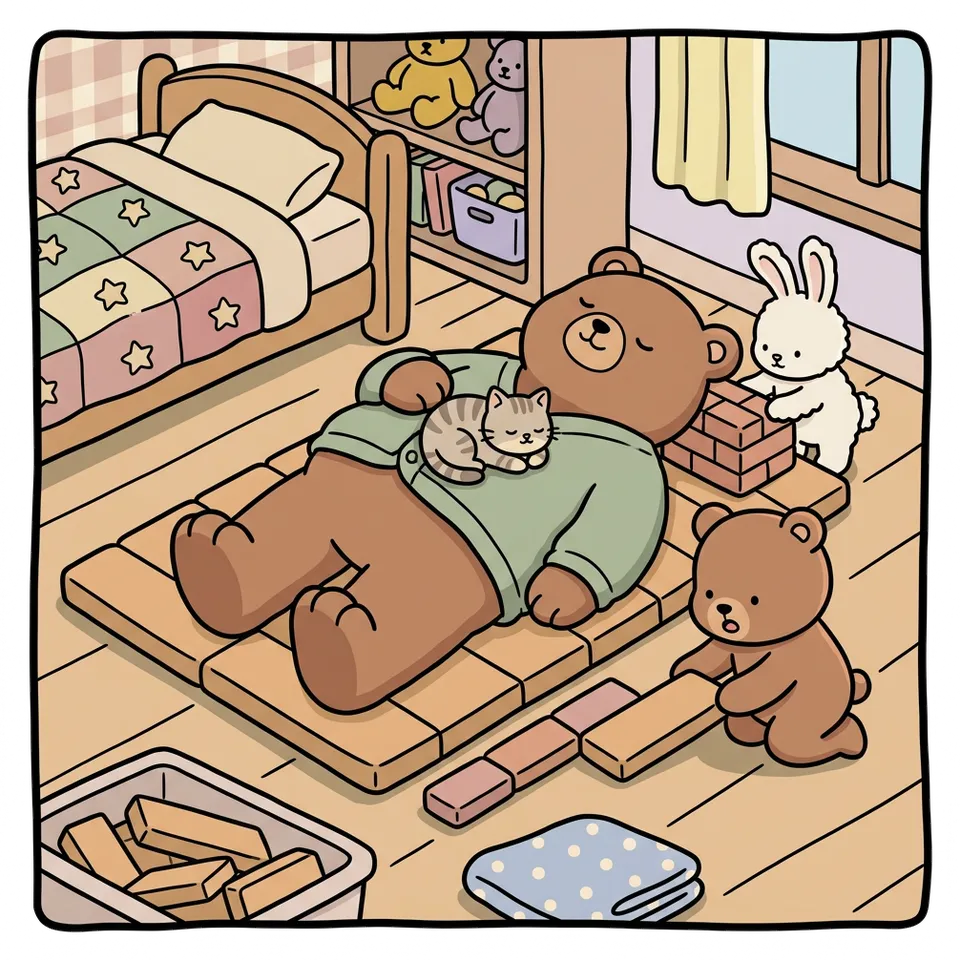
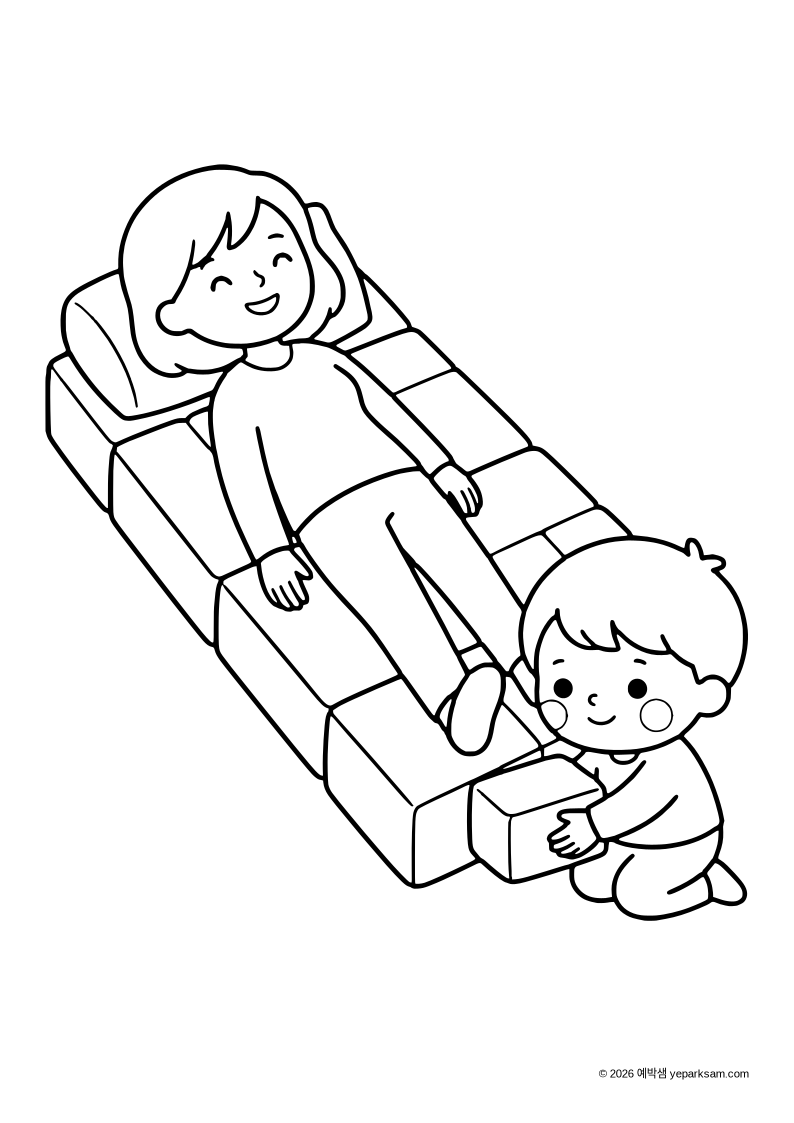
Join blocks side by side into a wide bed, and when a grown-up lies down, the child fixes up the bed to fit their body.
Why it's good
A child briefly lies on a bed a grown-up has built, but when the grown-up lies down first, the child starts rebuilding on the spot to fit that body. Building to the size of the person lying there is the fun of this play.
How to play
I used to build the bed first and then call the child. They'd come, lie down for a moment, and get right up again. The order was backwards. It's not the grown-up who builds, it's the grown-up who lies down. When I simply lay down on the floor, the child got busy right away. Seeing my feet stick out, the child linked a long piece onto one side, saying “Mommy is big, so I'll make a big house for you.”
A blanket just gets brought and put on, but with blocks they lengthen what's short on the spot. If a shoulder sticks out, they add a row to the side, and at the head they gather a few blocks for a pillow. But if I pretend to sleep and stay still, it doesn't last. If I lie there with my eyes closed, the child has nothing to do either. When I turn over now and then, the blocks under my body slide out of line. Then the child comes and puts them back, pats me while at it, and when they slide again, comes again.
Good to know
- It starts when the grown-up lies down first. If you build the bed and call them, they lie down briefly and leave, but when a grown-up lies down on the floor first, the child starts building to fit the body.
- Keep knocking things out of place rather than sleeping well. If you turn over now and then and push the blocks out of line, the child comes back, fixes them, and pats you, over and over.
- For a brick-block pillow, rest your arm on it and put your head on top. It still pokes, but that way you can lie there a good while without removing the pillow the child set down.
What you'll need
Wide blocks · Brick blocks
Giving Animals a Ride
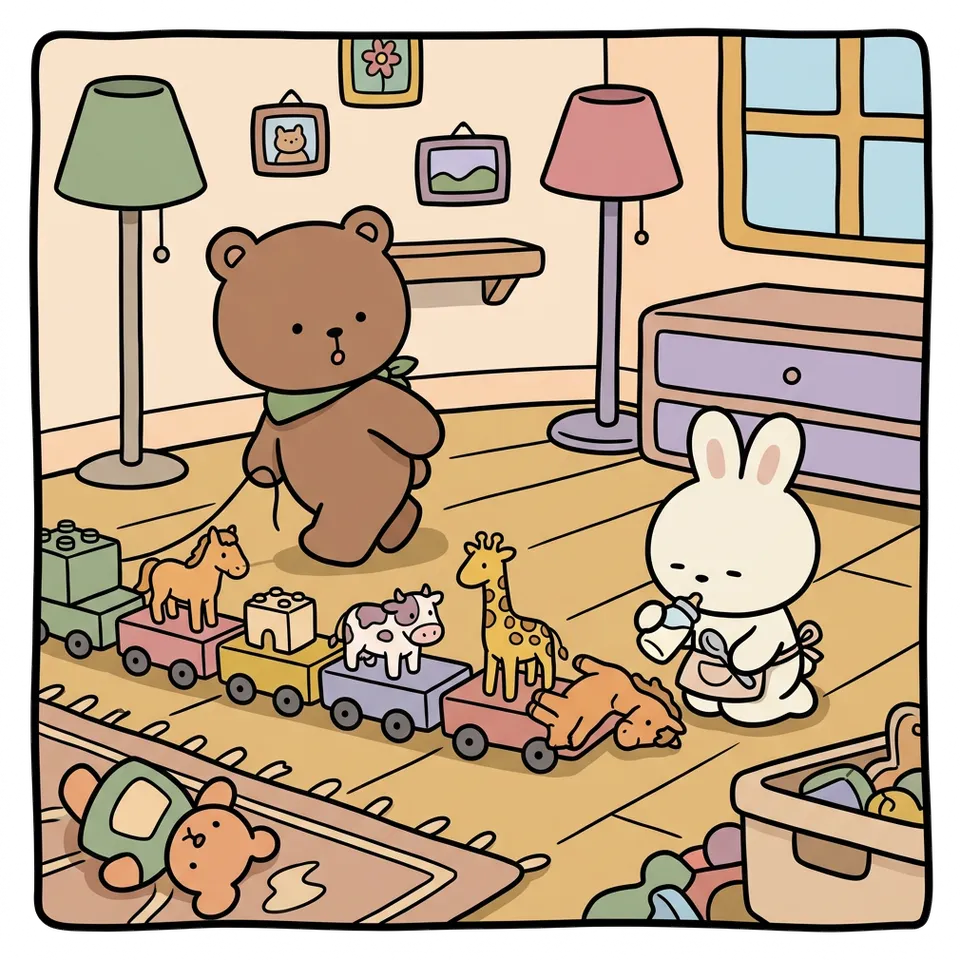
Line up long blocks and give animal figures a ride on top. If the blocks are snapped together, you can even pull them along.
Why it's good
At this age they're always the ones being given rides, but here they become the one giving the ride. What matters is less the riding itself than becoming someone who gave a ride, so when they've put everyone on, they always come to tell you.
How to play
Link a few long blocks along the floor and the top becomes the seats. The child puts the animals on one by one, and it's quick. Then they come to tell me. “Look, I gave a ride!” The place for riding doesn't have to be a block. A child who'd been lining up animals picked a big one, set a small one on its back, and said “Mommy and baby are here together.”
Animals that stood fine on the floor keep lying down on the blocks. That's because the blocks are narrow. But the child reads the fallen animal differently. When one horse tipped over, a child looked at it for a while and said “Maybe it's sick, it's lying down sleeping.” A child nearby heard that, brought a milk bottle and a spoon, and gave it medicine. When they were done, they said “Now our puppy has to take medicine too,” and took the riders down one by one to give them medicine.
If the blocks are snapped together, you can pull them along. Pulling makes them wobble, so every time the child comes back from a lap, one or two have fallen off. Then the child stops what they're doing, goes back, and puts them on again. It's not play about going somewhere but about putting the fallen ones back on, so it goes on a good while.
Good to know
- Animals keep falling because the blocks are too narrow. Animal figures have feet spread front, back, and to the sides, and one row of long blocks isn't that wide, so a couple of feet hang in the air and the animal tips over at the slightest touch.
- Put two long ones side by side and fewer fall. A few still fall, but putting those fallen ones back on is what keeps this play going a good while.
What you'll need
Long blocks · Animal figures · Milk bottle · Spoon
Set Up a Bowling Alley and Roll
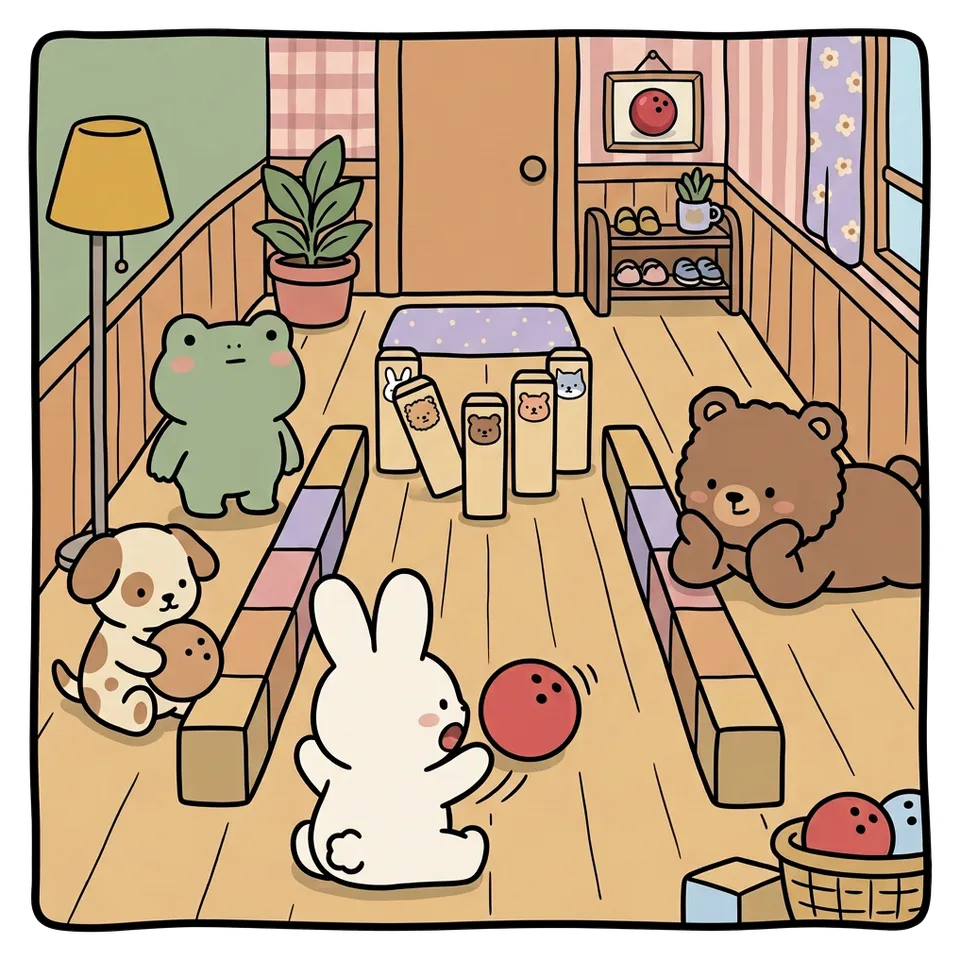
Stand a few blocks up, sit a little way back, and roll a ball to knock them down, like bowling.
Why it's good
It's play where children find out that a ball leaving their hand doesn't go where they want, and learn with their bodies that when walls block it, that failure turns into success.
How to play
Stand a few blocks up, sit a little way off, and roll a ball. But the ball doesn't reach the blocks. The moment it leaves the hand it veers off and rolls somewhere else. After a couple of tries, the child stops rolling, walks over, and drops the ball right on top. I thought the child just didn't know how to roll yet, but it was because rolling wasn't hitting anything.
If you line up a row of blocks along both sides from the rolling spot to the standing blocks, a ball that goes off course hits the wall and rolls back inward. Once even one block goes down, they start sitting and rolling from then on. Since the ball kept going out, one child brought a big block and blocked the side.
Some children like setting up better than knocking down. Even when I roll and knock everything down, they show no disappointment and set them back up one by one. On those days I take the rolling part.
Good to know
- Build the walls before the pins. The biggest job blocks do in this play is not the pins but the walls. With walls, a ball that goes off course rolls back inward.
- If they still won't fall, change the pins, not the ball. It's quicker than looking for a heavier ball. Big brick blocks with wide bases won't go down for most balls, but long ones stood on end go down even if the ball just brushes them.
- Stick faces or pictures on them and what children say changes. When they're plain blocks, it ends with “They fell”, but with a picture on them, children say what they hit.
What you'll need
Blocks · Ball
Tap-Tap Fixing
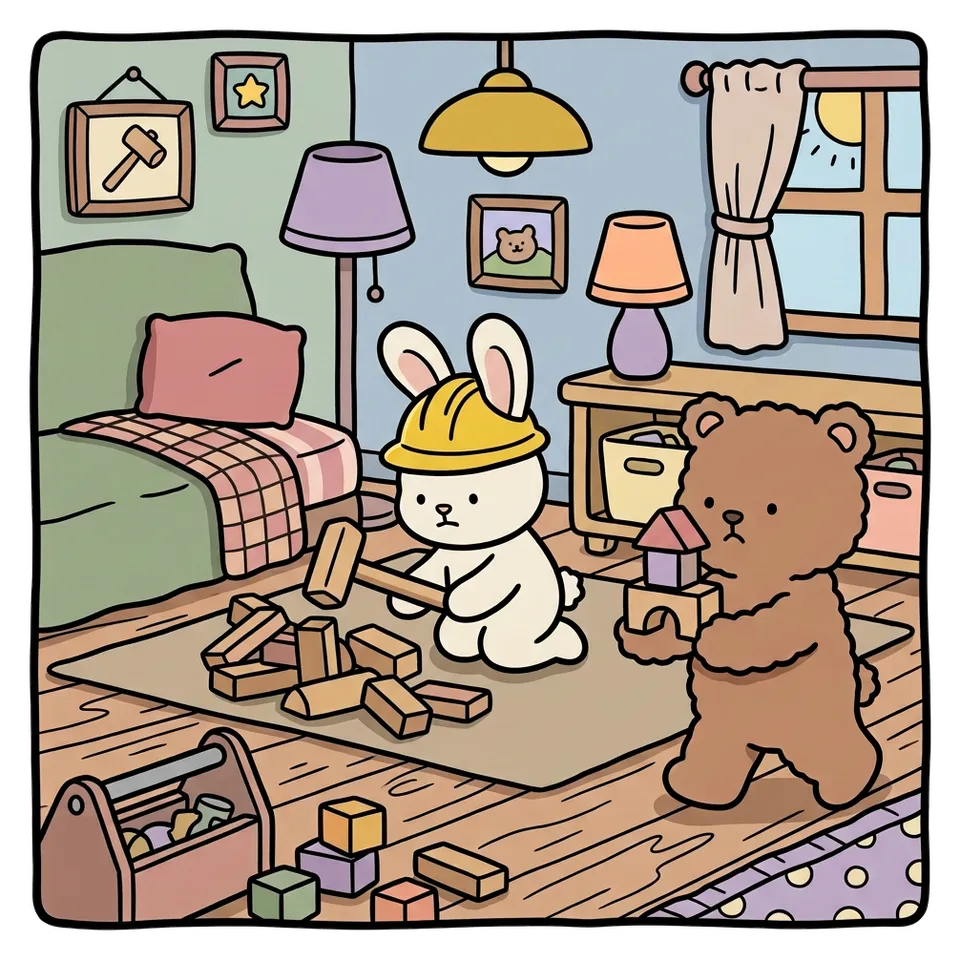
Tap the fallen blocks with another block as if you're repairing them.
Why it's good
If you don't clear away what has fallen right away, the child becomes a fixer on their own and goes around the room looking for broken things. After fixing, they have to test whether it really works for the play to go on, and words nobody taught them come out in the process.
How to play
I don't clear the fallen spot right away. My hands move first too, but if I hold back once, the play starts again from there. The moment a child picks up a long block, it becomes a tool. They tap the fallen spot saying “Tuk-tak, tuk-tak, construction!”
Once fixing starts, there's more and more to fix. A child nearby brings something perfectly fine and holds it out saying “Mine's broken too.” The fixing child taps it a few times and says “Fixed it.” The child who got it back plays and soon brings another. Then, saying “This one's broken too” and “This needs fixing too,” they go around the room.
When they say it's all fixed, I let them try it out right there. If you fix it and just leave it, it ends there. Only when they try whether it really works does play pick up again. A child rebuilt the fallen part and said “Now we can play again,” and carried on with the play as before. They also insist you look at what they've fixed. That's when “We have to make it strong!” comes out. I never taught them that, but it came out on the day they rebuilt something that had fallen.
Good to know
- You don't need a hammer. Any long block that fits in the hand becomes a tool.
- Bring over one broken thing and the child gets to work. A grown-up doesn't need to lay out many; hand over just one and even the child next to them brings theirs and goes around the room looking for things to fix.
What you'll need
Blocks
Stack to Your Height and Count
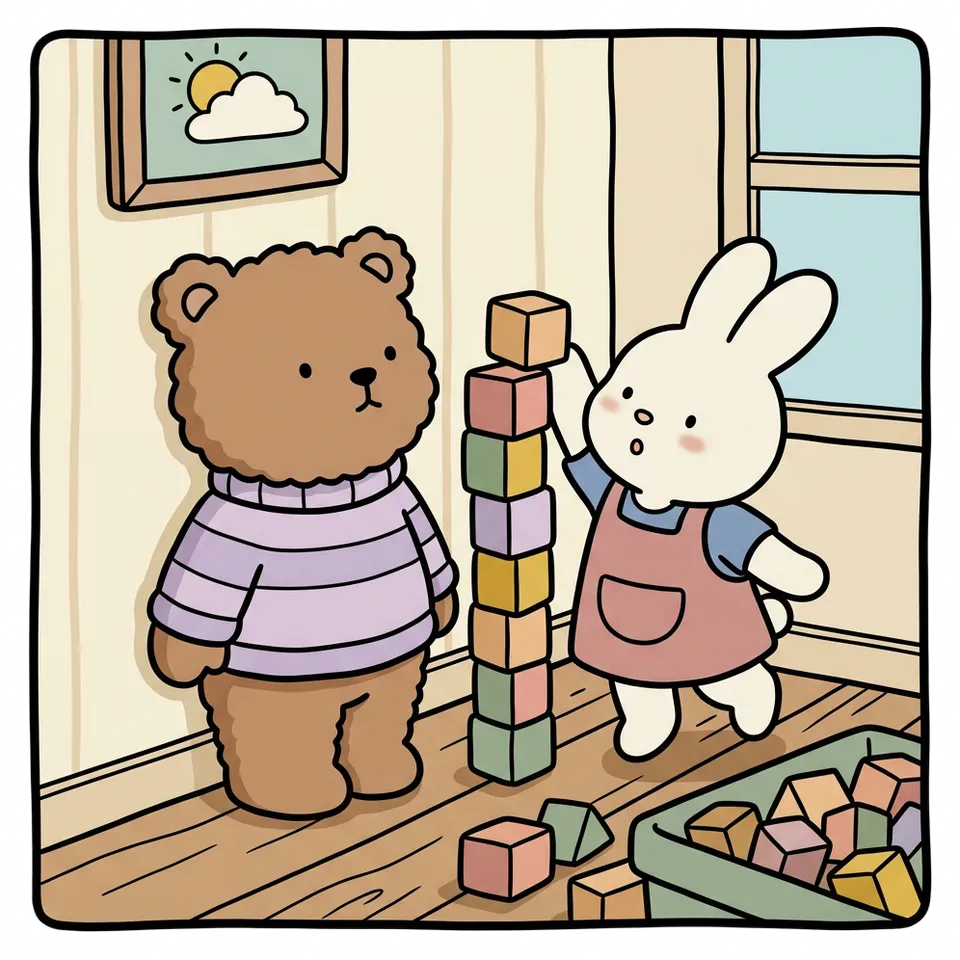
One person stands with their back to the wall while another stacks blocks from the floor up to their height. When it's done, count how many blocks it took.
Why it's good
A number written down means nothing to a child, but a number they counted themselves, pointing with a finger, is different. Counting their own height in blocks is play that makes numbers their own.
How to play
One person stands with their back against the wall, and blocks go up from the floor beside them. If there's only one child, the child stands and the grown-up stacks. The stacker looks back and forth between the blocks and the person standing. They say “Still below the head,” and their hands slow down. At shoulder height it's “Almost the same now,” and after placing the last one they say “Wow, it's exactly the same!”
When it's all stacked, I have them count how many. I once marked a line on the door frame and wrote the date, and the child never looked at it. But the block count is a number they counted themselves, pointing with a finger, so it's different.
After counting, a line forms. “How many am I?” says the next child, putting their back to the wall. The child measuring says “Take this one off,” and removes the one on top to fit the height. Once a number comes out, the child takes it somewhere else. A child who got fifteen blocks said “I'm 15 floors, and my house is on the 15th floor.” A child nearby said “My house is on the 4th floor.” From there, height-measuring became talk about the houses they live in.
Good to know
- Stack close to the wall. A single line gets wobblier the higher it goes, and the wall supports one side. But leave a hand's width from the person standing. If you stack right against the body, it spills straight toward the child when it falls.
- Use the same blocks every time you measure. With big blocks it ends around eight, and with small ones it goes past twenty, so if you switch you can't compare with last time's number.
What you'll need
Blocks
Roads for Cars
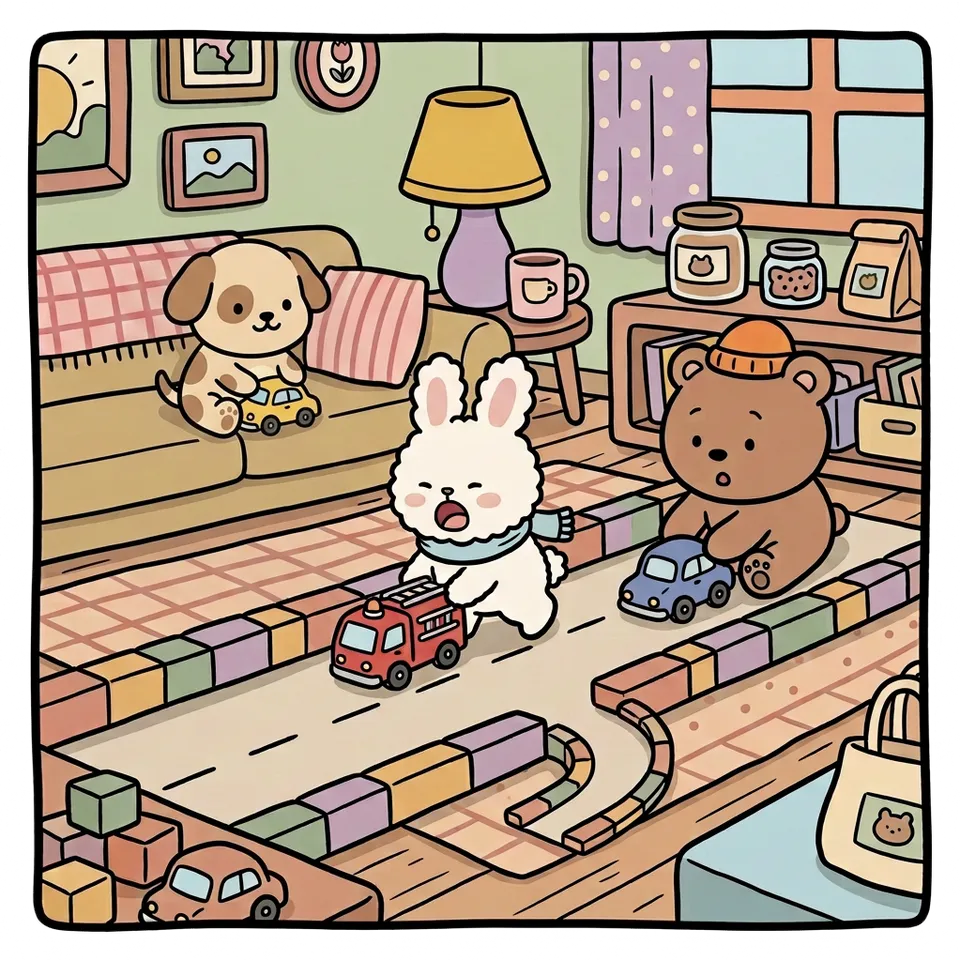
Lay blocks in two long rows to make a road, then push cars along between them.
Why it's good
The width you leave is what divides this play. Only if it's narrow enough for a single small car to just squeeze through do children meet an oncoming car and have to find a way to make it move aside.
How to play
At first I just laid the road and sat back. The child pushed a few times and quit. I understood after I took one car and entered from the other end. Having an oncoming car and not having one is that different. On a narrow road, one of them has to stop.
The child comes up with ways to make the blocking car move. Since my car was in the way, the child said “I'm the 119 (emergency) truck. There's a fire!” Then I have no choice but to move aside. From that day on, urgent cars keep showing up.
As the child pushes cars around, the backs of their hands brush the blocks, and little by little they slide out, and at some point the road breaks. The broken spot is the best spot in this play. The child said “It's blocked here. We have to make a detour,” and laid a new road off to the side. I still don't know where the word "detour" came from.
Good to know
- Space the rows just wide enough for a single small car to squeeze through. If it's roomy, cars just pass by each other, but when it's narrow there's a reason to make the oncoming car move.
- When laying the road, don't use up all the blocks; keep a handful aside. If you empty the bin, you can't make a way around when the road breaks.
What you'll need
Blocks · Cars
Fence In the Animals
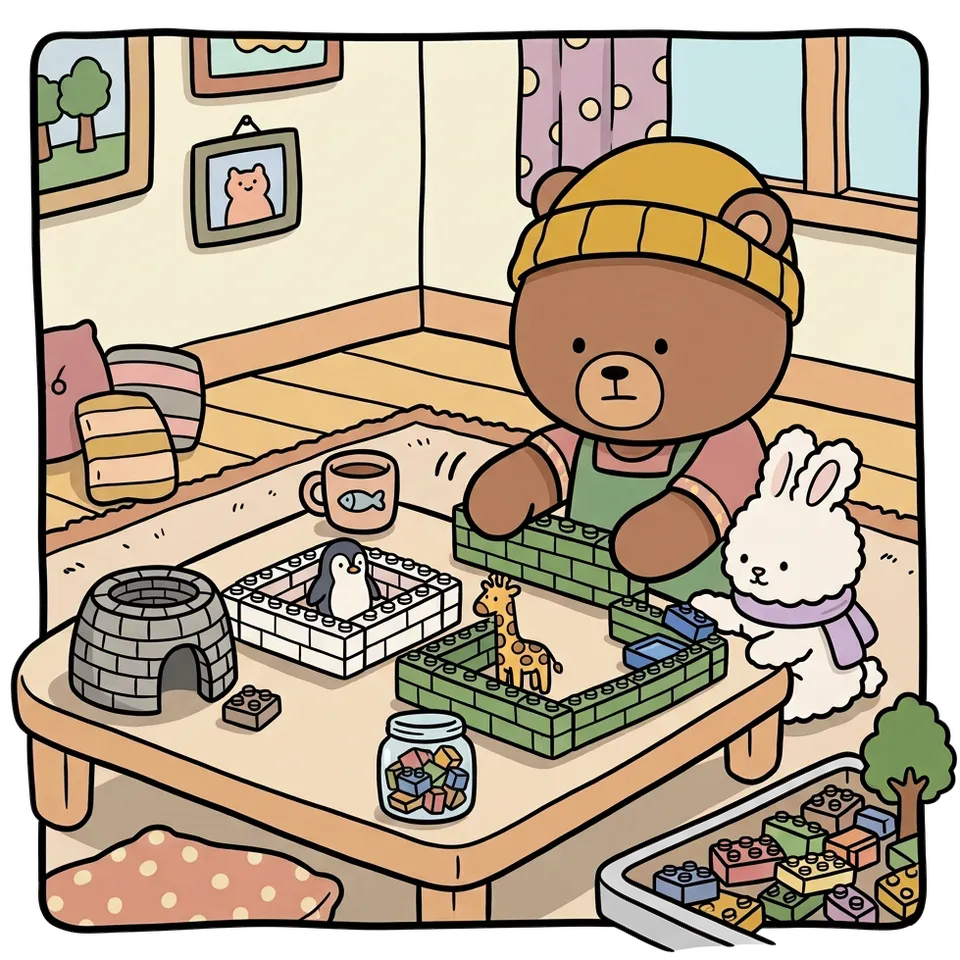
Build a zoo by fencing in a square with small blocks, then imagine what the animals living inside need and rebuild it to match.
Why it's good
A fence is done once it's built, but once children start thinking about what the animals inside need, it becomes play where they keep rebuilding. If it's cramped, they widen it, and if the animals live in different places, they divide the fence.
How to play
When I built the fence and even put the animals in, the child looked in for a moment and got up. It's because there's nothing left to do once everything is built. If I ask about the ones living inside rather than the fence, it changes from there. One child said “The animals feel squished if it's tight,” and the child beside them said “Then we have to make it big,” and pushed the wall out to widen it. A child also brought one blue block and put it inside, saying “Animals need water too.” That's the water bowl.
Once they know the animals live in different places, one fence won't do. They divide the space, saying “Penguins have to be somewhere cold” and “Giraffes live on the grassland, not the desert.” They push the figure between blocks because a squirrel's home is inside a tree, and put the bird's home up high because it's on a branch. A child making a bear den joined gray blocks into a round and covered the entrance, saying “Bears hibernate, so we have to close the door.” When they were done, they connected the homes to each other and said “The bear's house is next to the squirrel's house” and “The bird watches from above.”
Good to know
- Small blocks like LEGO work well. They're a good size for building a fence around a square.
- You can't pick up and move what's built. Walls that are only stood up, not snapped together, have nothing holding them, so they scatter if pushed. Start somewhere you won't need to move them.
What you'll need
Small blocks · Animal figures
Stand Them Up Like Dominoes
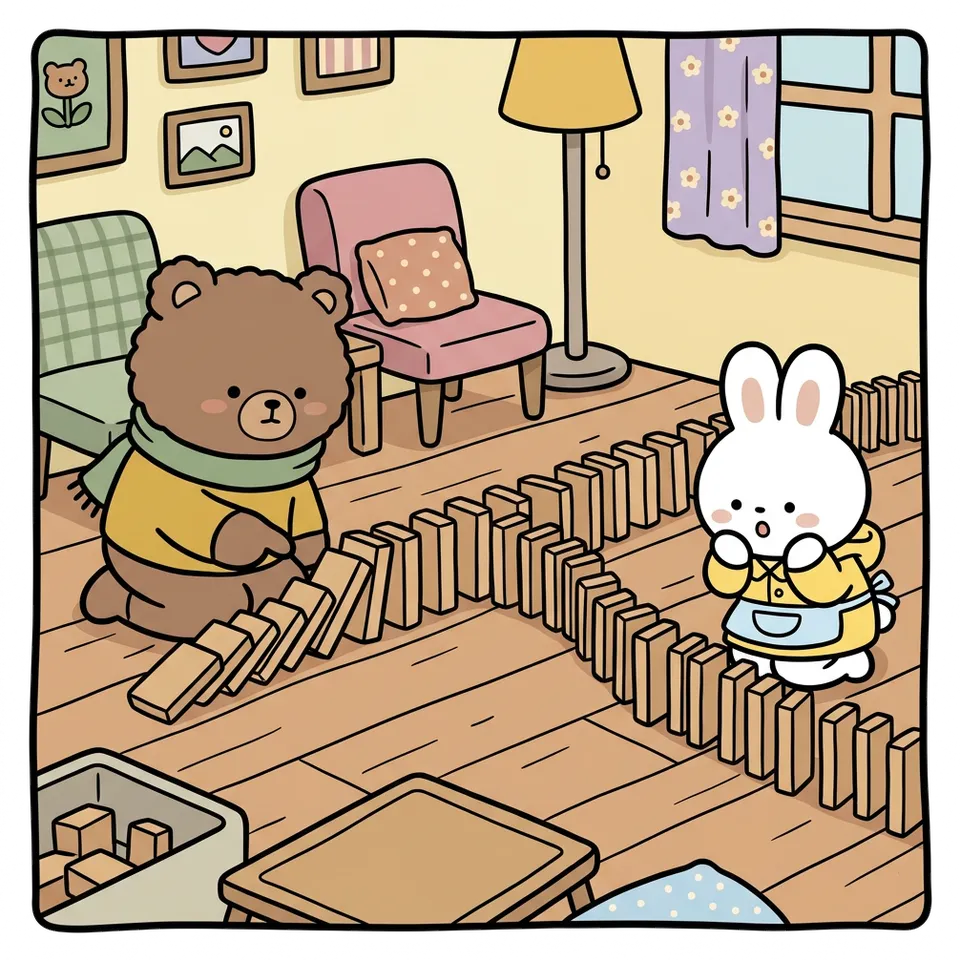
Stand blocks in a line and tap the first one so they fall one after another like dominoes.
Why it's good
Standing them up works with any block, but getting them to fall is where it gets stuck. Children find out that hitting hard actually doesn't work and that a light touch with a fingertip carries it to the end, and learn with their bodies that strength and results aren't always proportional.
How to play
Once everything is set up, the child swings an arm wide and hits the front one. They want to knock it down big. But the block that was hit hard flies off to the side, and the one right behind it stays standing. The one touched lightly with a fingertip actually goes all the way. If it stops in the middle, you don't have to set it all up again; you just tap that spot. The child does it first, before I lay a hand on it. They reach to where it stopped and tap it, and when another one stands, they tap again, carrying it through to the last one.
At first they stand them very close together. When they're pressed together, the one in front has no room to fall and just leans and stops. The child said “Don't put them too close,” and started spacing them out. But this time they're too far apart and it keeps stopping in the middle.
As the line gets longer, it starts crossing the room and gets stepped on by people passing. I folded up the table and moved the chairs out of the living room. With the floor open, the straight line became a curved road and even got a fork. When I held my fingers out side by side and suggested counting to three and pushing together, from then on the two of them did that on their own.
Good to know
- Space them so a fallen block reaches the next one, closer than the standing height. If they're pressed together there's no room to fall and they just lean and stop, and if they're too far apart they keep stopping in the middle.
- If they keep falling over, switch to bigger blocks. Small blocks lie down at a brush of the back of a hand, so the child quits before getting them all up, but big blocks hold while you set them up, so the line gets much longer. Just space them wider to match the bigger size.
What you'll need
Blocks
Open a Shop and Sell
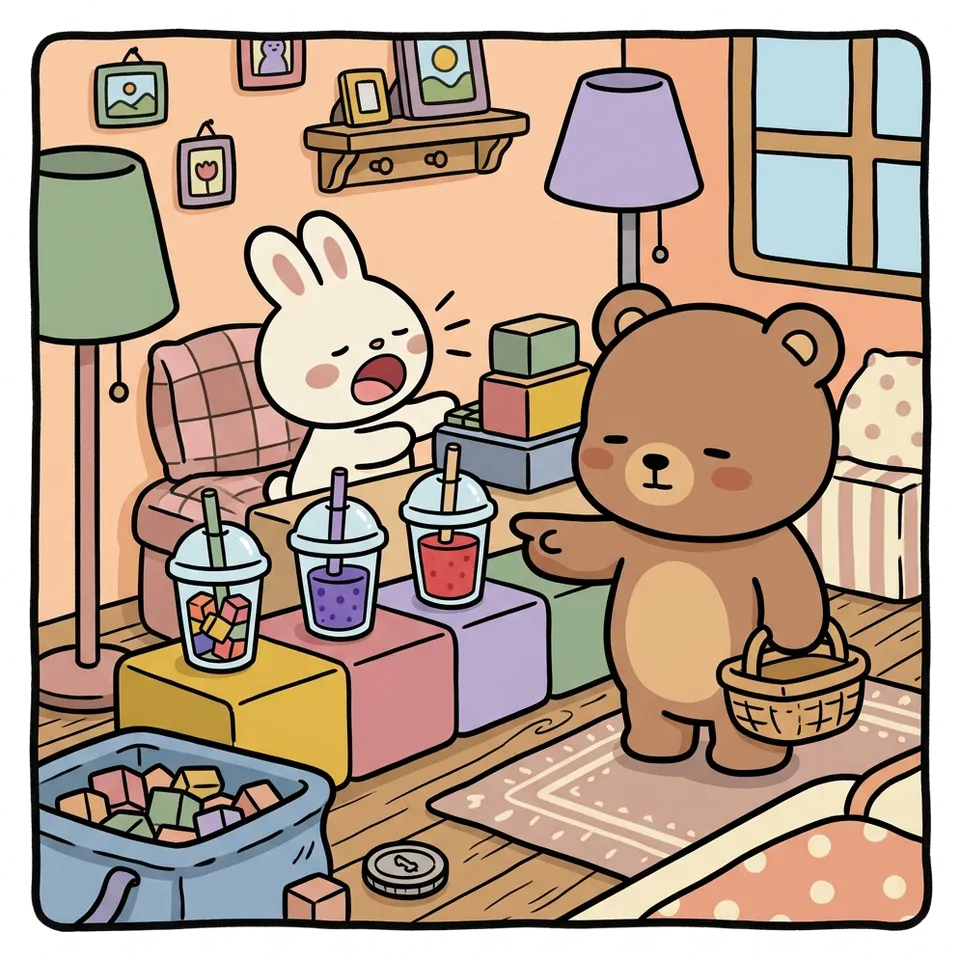
Lay blocks in one long row to make a shelf, set things on top, and play shop.
Why it's good
Shop play ends quickly not because there's nothing to sell but because there's nowhere to lay things out. Once there's a shelf, children play longer dividing up the checkout spot and the spot for goods than selling, and they make up the steps of asking prices and paying on their own.
How to play
At first shop play ended quickly, so I kept taking out more toy dishes. Only on the day I laid blocks in one long line did the shop open. After that, they play longer making the spaces than selling. They divide it into sections with blocks, saying “This is where you pay” and “This is where the stuff goes.”
What's sold is also blocks. Put small blocks in a clear cup and it's juice. The color becomes the flavor. They put in red and say “It's watermelon juice,” then when another color mixes in, “It became grape juice,” and when more mix in, “This is weird-flavor juice,” and laugh. They pour saying “I'll put in lots,” then stop themselves saying “This is going to overflow.”
There's always a spot for paying too. They stack a few blocks and say “Beep! That's 1,000 won.” The price is different every time you ask, but nobody argues. In shop play, the grown-up who buys has more work than the child who sells. You choose, ask the price, pay, take it, and even pretend to eat it before the next thing comes out. When I get tired after a round, I say I'll do the selling. Then the child takes a basket and becomes the customer, and from then on asking prices and paying is the child's job.
Good to know
- Before the shop is fully set up, going to buy doesn't get you much. It's better to wait until it's ready.
- They pick up the sound of paying before the words for selling. Checkout sounds like “Beep! That's 1,000 won” come first, and the price changes each time you ask but nobody argues.
- Stick in a straw. They even carry the juice they made around and pretend to drink it.
What you'll need
Blocks · Clear cup · Straws · Basket
Build a Fire Pit and Light the Fire
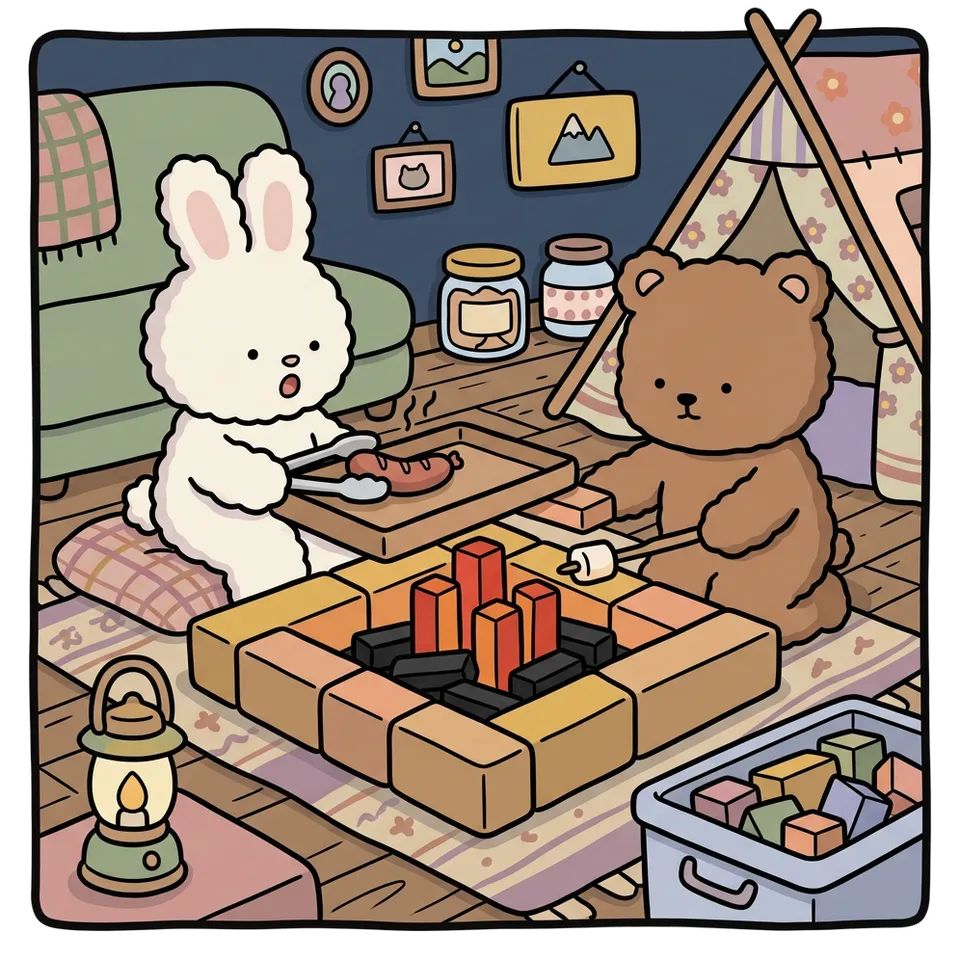
Build a square fire pit from blocks, make charcoal and flames from colored blocks, and pretend to grill meat over it in a camping game.
Why it's good
Play that used to end after a few grilling motions once you handed over a plate grows into building play with one question about what should be under the grill. Building the pit and making fire out of color becomes play that lasts longer than the grilling itself.
How to play
To a child who was putting a plate on the floor, flipping meat a few times, and about to get up, I asked what should be under the grill. That one question brought out everything they'd seen at the campsite. “You need charcoal,” “You need fire to grill meat,” and then they added one more: “I saw a stone fire pit too.” Then nobody told them to, but they went to the block bin.
The middle is left empty because the fire goes there. The fire is made of color. They pick black ones for the bottom and call them charcoal, and stand red and orange ones on top and call them flames. Digging through the bin to pick out colors takes a long time, and some days that lasts longer than the grilling. Only when everything is up do they pick up tongs and make the sound “Sizzle~ sizzle~”
Once there's fire, the grown-up's only job is to treat that fire as real. A child stuck a white piece on the end of a long block, called it a marshmallow, and held it right over the fire. I said it's too close and it'll burn, and the child said “Then I need to put in one more brick!” and slipped in one more block between to lift the marshmallow higher. All I did was say one worried thing, but the child measured the height and fixed it.
Good to know
- Leave the pit hollow and just ring the edge in a square. The more you put on top the better, and the top needs to rest across both sides of the edge; a small plate falls inside, and a tray fits best.
What you'll need
Blocks · Tray · Long blocks · Tongs
Look at a Field Guide and Build an Insect
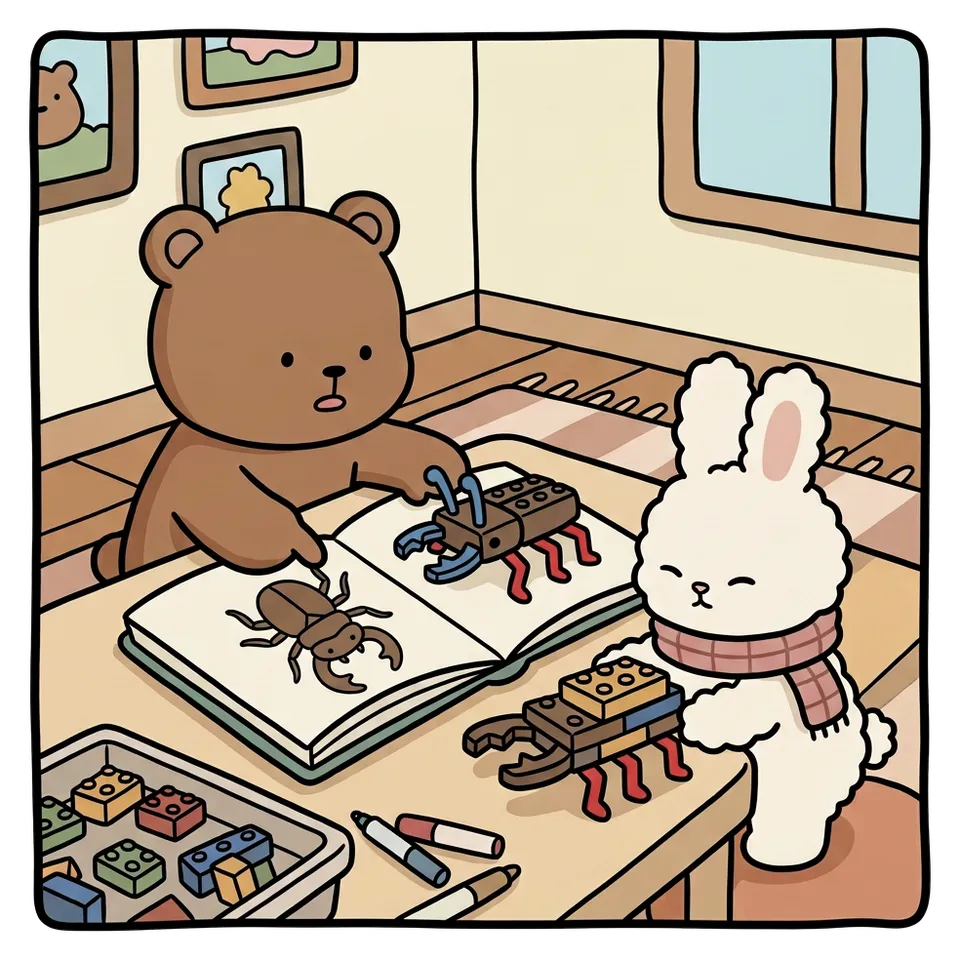
Open an insect field guide and build insects from blocks while looking at the pictures.
Why it's good
When the picture is open right in front of them, children count and snap together how many antennae and how many legs there are and where they attach. These are things they learn not by memorizing but by building while looking.
How to play
Setting out something to look at works better than deciding what they should build. If you just tell them to build, they snap on a few pieces and stop, but if you open a book for them, how long they sit changes. One where the pictures are big and one insect takes up a whole page, like an insect field guide, is good. I put insect photos on the wall and told them to look, but the child kept getting up from building, going to the wall and sitting back down, over and over, and then just quit. When I took them down and put them on the table next to their hands, they stopped getting up.
Once it's set out, they start counting. A child building a stag beetle said “A stag beetle has 2 antennae, so I put these small blues here, and the legs, 4 on each side, I'll connect with small reds,” and snapped them on, even dividing by color. They got the antennae right but went off on the legs. Even with the picture right under their nose, they came out with eight. I didn't tell them it was wrong. I just suggested we count again, and they counted pointing at the picture and took two off. Some children don't take them off. If they say their stag beetle has eight legs, you just leave it.
The child next to them deliberately makes theirs different. They said “I'll make a stag beetle too. I'm going to make a bigger stag beetle,” and thickened it by sticking blocks on two layers at a time. With the same picture open, the same thing never comes out. When they're done, I ask where to put it. If you just say it's well made, it easily goes straight back into the bin, but if you ask where they'll put it, the child goes off to choose a spot. One child set it somewhere it showed well, said “I'll go write its name too,” and went to get a marker and paper. That day the play didn't end with building but went on to naming.
Good to know
- Insects have six legs. I looked it up that day and learned it myself. Many children make eight, but eight is spiders, and spiders aren't insects. The legs are all gathered on the middle section, not along the body's sides.
- Open it on the table next to their hands. If it's on the wall, they keep getting up from building to go look and come back until they quit, but if it's next to their hands, they don't get up.
What you'll need
Blocks · Insect field guide · Marker · Paper
Flip It Over and Spin It
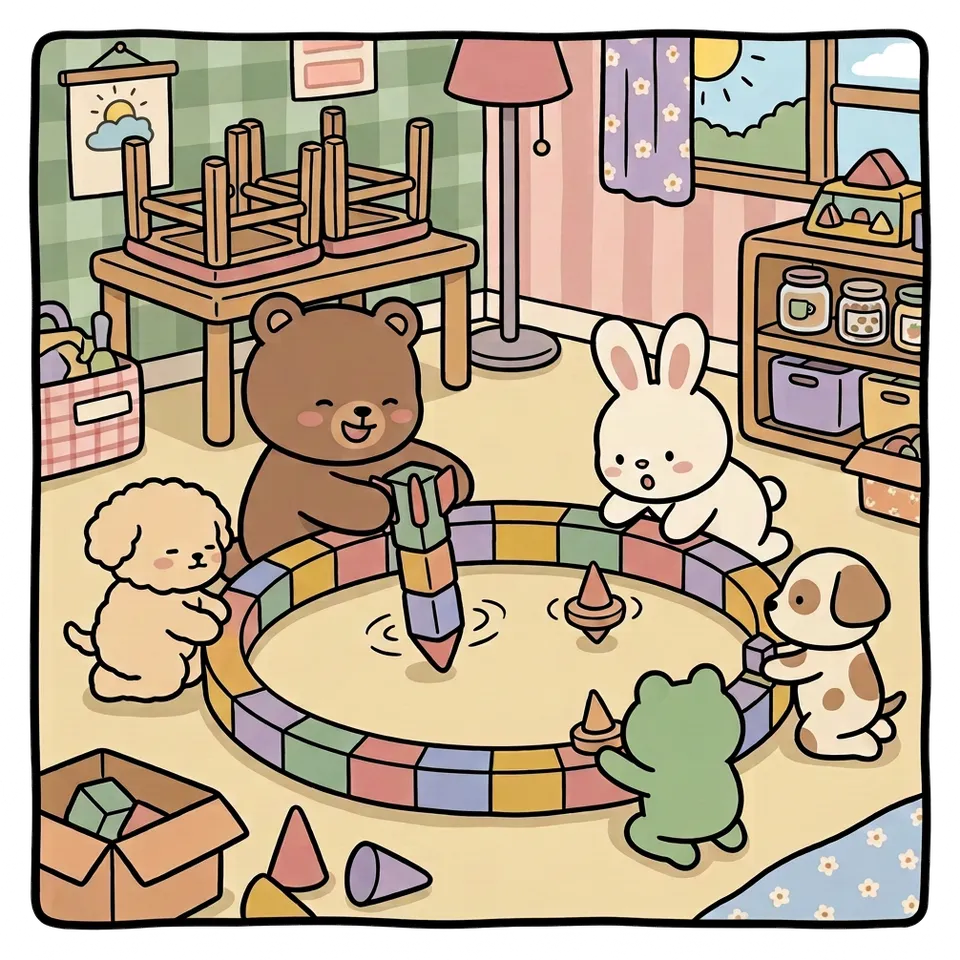
Flip a block piece you've been building, stand it on its point, and spin it, and it becomes a top. If the part touching the floor is narrow and pointed, it spins.
Why it's good
Nothing special needs to be made. Just watching a block that fell while building spin by itself starts the play, and since not all of them spin, digging through the bin to find a good spinner on their own is the fun in itself.
How to play
A child who brought over a rocket showed it to me, said “This is a rocket, but if you turn it upside down like this, it's a spinning top,” and spun it right there. I didn't know it was a top until the child flipped it. Nothing has to be built for it to spin, either. A child building an amusement park saw a block that had fallen on the floor spin by itself and said “This one really spins well!” From then on they left what they were building and dug through the bin to spin the pieces one by one.
Soon the word "small" comes up. Because the top kept falling off the table, one child said “Mommy, the table is too small for playing spinning tops.” I pushed the table aside and cleared the floor. Once there was room, “I think we should make a spinning-top arena” came from the child first.
The children fix the size. A child who saw one made small with four blocks said “Isn't this too small?” and they brought more and widened it.
When an arena is up, the tops gather. Siblings and friends who came over look in, make their own, bring them, and ask to play together. This was the play that lasted longest that day.
Good to know
- Not all of them spin. A child who finds a good spinner keeps it in their hand, and if they find a better one, they sometimes trade.
- An arena beats a line drawn on the floor. A top just crosses a line, but blocks are a wall, so it bumps and stays inside. There's nothing to stack high; a single layer joined together is enough.
What you'll need
Blocks